How Mobile Apps Help Waste Haulers Manage Stops, Photos, and Real-Time Updates
Why Waste Haulers Need Driver Apps in 2026
The waste and recycling industry has spent decades relying on paper manifests, radio communication, and end-of-day reporting. That approach creates delays, loses revenue to missed pickups, and leaves customers without visibility into service status. A mobile driver app closes these gaps by putting real-time information and operational control directly in your drivers' hands while they work.
Customers today expect the same level of transparency they get from food delivery, ride-sharing, and e-commerce services. When a driver is scheduled to arrive at 10 a.m., businesses want to know when the truck is actually two minutes away. When a container is full and needs an emergency swap, dispatchers need confirmation within seconds, not hours. Driver apps make this standard, not premium.
Real-Time Stop Management and Proof of Service
The core job of a driver app is managing each stop on a route with precision. When a driver arrives at a location, they can clock in, view the service details (container size, pickup frequency, special instructions), and mark the stop as complete in seconds. This eliminates the gap between when work actually happens and when dispatch knows about it. Instead of waiting until 5 p.m. to learn a stop was missed, your dispatcher sees it immediately and can route a follow-up truck or contact the customer before they call with a complaint.
Proof of service is equally critical. A photo of the full container, the label, or the collection point creates an irrefutable record that work was performed. If a customer disputes a charge or claims a pickup never happened, you have visual evidence. These photos also feed into your invoicing system automatically, ensuring accuracy and reducing billing disputes. For operations running multiple yards or contracted drivers, this documentation becomes essential for accountability and quality control.
Photo Capture and Digital Documentation
Photos have become the fastest way to resolve waste hauling disputes. A driver snaps a picture of a blocked or inaccessible container, and dispatch sees it in real time. They can immediately contact the customer to remove the obstruction, reschedule the pickup, or add a service charge if access issues require extra labor. Without this visual layer, drivers waste time, customers get frustrated, and revenue slips away.
Photos also serve as training and compliance tools. If a driver consistently fails to position containers properly, captures incomplete shots, or misses hazardous waste documentation, management can review the photo record and provide coaching. In regulated markets, photo timestamps and metadata satisfy audit requirements. Some haulers use photos to flag potential safety issues—a customer stacking loads unsafely, for example—and proactively address them before an accident occurs.
Customer Status Updates and Real-Time Communication
One of the highest-value features of a driver app is the ability to send automated or manual customer notifications. When a driver marks a stop complete, the system can instantly message the customer with a time stamp and optional photo. For scheduled pickups, customers receive a "your pickup is next" alert five minutes before arrival. For emergency calls, a driver can notify customers immediately that they're en route. This transparency reduces follow-up calls to dispatch and builds trust.
Two-way communication also works in reverse. If a customer has a special request or notes a problem (overfilled bin, new service location), they can message the driver directly through the app. The driver sees the alert, acknowledges it, and solves the issue on the spot. This real-time back-and-forth eliminates the game of tag between customer, driver, and dispatcher. For haulers managing high-volume routes or emergency calls, this speed is a competitive advantage and a customer retention tool.
Route Optimization and Fuel Efficiency
A driver app doesn't just record what happens—it shapes what happens. When stops are logged in real time with geolocation, dispatch gains visibility into actual travel times and can optimize remaining stops on the fly. If a truck is running ahead of schedule, dispatch can add a nearby stop. If weather or traffic causes delays, they can reassign lower-priority work to the next shift. This dynamic flexibility reduces empty miles, prevents overtime, and maximizes the number of stops per truck per day.
Over a year, even modest improvements in route efficiency compound into thousands in fuel savings. A driver app integrated with mapping software ensures drivers take the fastest, most cost-effective routes from the start. GPS data also creates a historical record of actual driving patterns, which reveals opportunities for optimization that routing algorithms alone might miss. Some haulers use this data to identify problem routes, adjust service areas, or renegotiate contracts based on real drive times.
Integration with Dispatch and Invoicing Systems
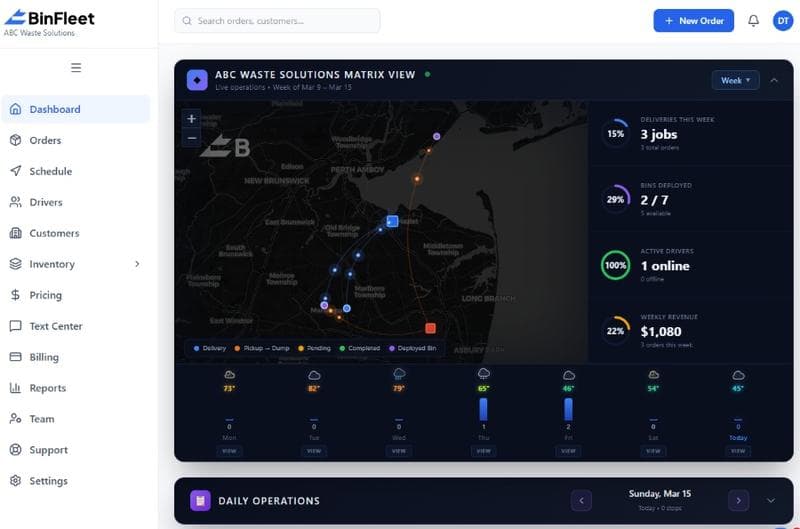
A standalone driver app is useful, but one that integrates with your dispatch, inventory, and billing systems becomes transformational. When a driver completes a stop, the app instantly updates the central dispatch board, flags the container as serviced, updates GPS coordinates, and logs billable details. The office team sees all this in real time and doesn't need to manually enter data or chase drivers for information. Read more about dispatch optimization in our blog to understand how this integration speeds up operations.
Integration also powers accurate, timely invoicing. Photo proof, geolocation, and time stamps create an audit trail that invoices can reference. Customers receive bills backed by timestamped evidence, which reduces payment disputes and speeds cash collection. For multi-yard operations, consolidated driver data creates company-wide visibility and simplifies month-end reconciliation. See how BinFleet connects driver data to your entire operation in a live demo.
FAQ: Driver Apps for Waste Haulers
What happens if a driver works in an area with poor cell coverage?
Quality driver apps function offline and sync data automatically when connectivity returns. Drivers can complete stops, capture photos, and record updates on their device. Once the truck re-enters cell range, all data uploads to your central system instantly. This prevents service gaps and keeps workflows moving even in remote or rural areas.
Do driver apps increase labor costs or create pushback from drivers?
Driver resistance typically fades quickly once they experience the benefits: less time waiting on dispatch for directions, fewer disputed stops, and instant access to customer details and payment requests. Apps also reduce manual paperwork and radio chatter, making the job easier, not harder. When rolled out with clear training and framed as a tool that supports drivers, adoption is typically smooth.
Can a driver app work for both scheduled pickups and emergency/same-day calls?
Yes. A driver app manages both planned routes and ad-hoc jobs seamlessly. Dispatch can assign emergency calls to the nearest available truck in real time, and the driver sees the new stop instantly on their route. Photo and status updates work the same way, so there's no distinction in the workflow between routine and urgent work.
How much does a driver app cost compared to managing everything on radio and paper?
A purpose-built driver app is typically a per-truck monthly subscription, often $30–$50 per vehicle. Over a year, that's offset by fuel savings, reduced disputes, faster invoicing, and fewer missed stops. Most haulers recoup the investment within the first few months through operational gains alone.
Getting Started with Driver Technology
Implementing a driver app is simpler than many haulers expect. Modern platforms require minimal infrastructure—just iOS or Android devices and basic connectivity. Training is straightforward because the interfaces mirror everyday apps drivers already use. The key is choosing a platform built specifically for waste and recycling, not a generic logistics tool that requires customization.
If you're ready to see how a driver app transforms your operations, request a demo of BinFleet and watch how real-time stop management, photo capture, and customer updates work together. Or explore BinFleet's full platform to understand how driver technology connects to dispatch, invoicing, and customer communication. Start your free trial today to experience the difference real-time visibility makes for your business.
Ready to Streamline Your Operation?
See how BinFleet AI helps waste haulers save time, cut costs, and grow.
Request a Free 30-Day TrialRelated Articles
How a Mobile Driver App Transforms Waste Hauling Operations
Driver Apps for Waste Haulers: How Mobile Technology Transforms Daily Operations