How a Driver App Transforms Waste Hauling Operations
The Real Problem: Disconnected Drivers and Blind Operations
Most waste hauling operations still rely on paper routes, radio updates, and phone calls to track what drivers are actually doing. A driver pulls up to a job, completes the pickup or dump, and management has no way to verify it happened until they call or check back at the yard at the end of the day. This creates a cascade of problems: missed stops go unnoticed until customers complain, dispatch can't reliably reschedule when emergencies happen, and billing disputes arise because there's no documented proof of service.
The operational cost of this disconnect is staggering. A dispatcher stuck making confirmatory calls wastes 10–15 minutes per route. Drivers can't efficiently handle last-minute additions because there's no way to push them to the field instantly. And when a customer claims a pickup never happened, you have nothing but your driver's word—which creates friction and erodes trust. A mobile driver app solves this by putting real-time visibility, accountability, and communication directly in your driver's pocket.
What a Modern Driver App Actually Does for Waste Haulers
A purpose-built driver app does far more than GPS tracking. It guides drivers to their next stop with turn-by-turn navigation, displays job details (container size, special instructions, customer contact info), and lets drivers mark stops complete with a single tap. The app captures photos automatically when a stop is marked done, creating an auditable record that the container was picked up or dropped off. Real-time status updates flow back to dispatch and can trigger automatic SMS notifications to customers—"Your dumpster has been picked up" arrives within seconds of actual completion, not hours later.
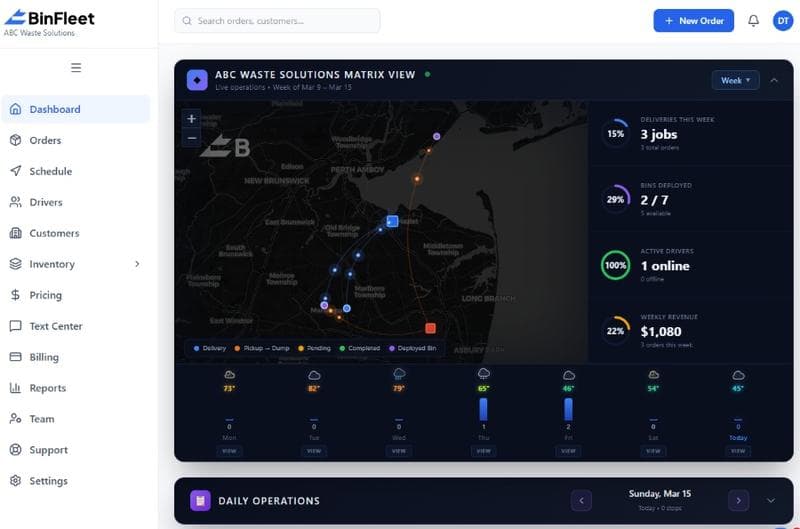
When a driver encounters an issue—a blocked driveway, a locked gate, an overfull container—they can document it with photos and notes right there on the job, flagging it for the dispatcher to handle. This eliminates the guesswork and gives your team the information they need to follow up properly. The app also tracks actual travel time versus driving time, helping you identify route inefficiencies and optimize assignments. For multi-yard operations, dispatchers see every driver's real-time location and job status on a single map, making it easy to reassign work or handle unexpected load-outs.
How Photo Capture Improves Accountability and Dispute Resolution
Photos are the currency of accountability in waste hauling. A driver snaps a picture at each stop—showing the container before pickup, the truck bed after, or the drop-off location—and those images are timestamped and linked to the job record forever. This eliminates the "we never picked it up" argument; you have proof. Customers also appreciate the transparency; they can see in their portal that their job was done, which reduces support tickets and builds confidence in your service.
From a business standpoint, photos are your shield in dispute resolution. If a customer claims damage, a missing container, or incomplete service, you have visual evidence. Insurance companies, regulators, and customers all value documented proof. The app makes capture effortless—most modern systems even auto-photograph when a driver marks a stop complete, so there's no extra step to remember. This shifts your operations from reactive problem-solving to proactive documentation, and that shift alone can reduce chargeback claims and customer friction significantly.
Real-Time Visibility Helps Dispatchers Make Better Decisions
When your dispatcher can see every driver's location, job status, and upcoming stops on a live map, they move from reacting to problems to preventing them. A driver is stuck in traffic and running behind? The dispatcher knows immediately and can either reassign the next stop to another truck or proactively notify affected customers. A stop comes in as an emergency add-on? The dispatcher can find the driver nearest to that location and push the new job to their app in real time, with directions and customer details waiting when they arrive.
This visibility also surfaces patterns. You start to see which drivers consistently finish faster, which routes have hidden delays, and where geography is creating unnecessary travel time. Over weeks and months, that data lets you rebalance route assignments, adjust pricing for certain zones, or identify where a second truck might generate enough new revenue to pay for itself. Real-time dispatch also reduces the need for dispatchers to make constant phone calls—the app becomes the source of truth, freeing them to focus on strategic problem-solving rather than status-checking.
Automatic Customer Updates Build Trust and Reduce Support Calls
Many waste haulers still rely on customers calling to ask "When is my dumpster coming?" A driver app can automatically send SMS or app notifications the moment a stop is marked complete, eliminating that question entirely. Customers get a confirmation message with a timestamp and photo, giving them certainty that the job was done. This simple automation reduces inbound support calls by 20–30% in most operations, freeing your office team to handle other tasks.
The transparency also strengthens customer relationships. Instead of waiting and wondering, customers see proactive updates. This is especially valuable for recurring pickups where a customer checks their app and sees "Container picked up today at 10:47 AM" without having to call. That small moment of reassurance builds trust and makes customer retention easier. When you combine automatic updates with photo proof, your service moves from transactional to transparent, and transparent operations have significantly lower churn.
Integration with Dispatch and Billing Closes the Data Loop
A driver app that lives in isolation is useful, but a driver app that feeds directly into your dispatch system, inventory tracking, and billing system is transformative. When a driver marks a stop complete, that job is automatically closed in dispatch, the container status updates in inventory, and the work order moves into the billing queue—all without manual data entry. This eliminates the gap between what actually happened in the field and what gets recorded in your system, which is where errors, double-billing, and missed revenue usually hide.
This integration also means your team stops re-entering data. The driver captures it once on their phone, and it flows through your entire operation. Fewer manual steps means fewer mistakes, faster invoicing, and more accurate reporting. If your driver app integrates with your payment processing, you can even invoice same-day and accept payments immediately, improving cash flow. The cumulative effect is an operation that runs faster, with fewer people doing manual work—which is exactly where efficiency gains pay real money.
FAQ: Driver Apps for Waste Haulers
Do drivers really use these apps, or do they resist them?
Good apps are adopted quickly because they make drivers' jobs easier, not harder. A well-designed driver app shows the next job, turn-by-turn directions, and customer details without requiring the driver to hunt through paperwork or radio dispatch. Most drivers appreciate the clarity and the automatic work documentation; it also protects them by creating a record of what they actually did. Resistance typically comes from poorly designed apps or ones that feel like surveillance rather than tools—so the UX and purpose matter enormously.
How secure is customer data captured in a driver app?
Enterprise-grade driver apps use encrypted connections, secure servers, and role-based access controls to protect photos and customer information. Photos are timestamped and linked to specific jobs, and access logs show who viewed what. The same security standards that apply to payment processing and customer databases apply to driver app data. Check that your provider is SOC 2 compliant and encrypts data both in transit and at rest.
Can a driver app work with my existing dispatch software?
Most modern driver apps integrate with major dispatch platforms via APIs, so they don't require you to replace your entire system. Some haulers use BinFleet or similar integrated platforms that bundle dispatch, driver app, customer portal, and billing in one system, which eliminates integration headaches. If you already have dispatch software, ask whether your provider has a native driver app or a certified API integration—avoiding a separate, disconnected app is worth asking about.
How much does a driver app cost, and what's the ROI?
Driver app pricing typically ranges from $5–$15 per driver per month depending on features, or as part of an all-in-one platform. ROI comes from faster invoicing, fewer support calls, reduced disputes, improved route efficiency, and lower manual data entry labor. Most operations see positive ROI within 3–6 months, especially if they're currently using paper routes or doing heavy manual dispatch. The return compounds over time as you optimize routes based on real data.
Getting Started with Driver Apps in Your Operation
Switching to a mobile-first waste hauling operation doesn't require ripping out your entire system. Start by evaluating your current pain points: Are you losing time on manual data entry? Are customers confused about job status? Are you unable to add last-minute stops without chaos? A driver app addresses all of these. If you're looking for an integrated solution, schedule a demo with BinFleet to see how dispatch, driver app, customer portal, and billing work together. If you want to learn more about modern dispatch workflows, read our latest operations guides or visit our homepage to explore the full platform. The haulers winning market share in 2026 are the ones giving drivers and dispatchers real-time visibility and automation—not the ones managing routes on clipboards and spreadsheets.
Ready to Streamline Your Operation?
See how BinFleet AI helps waste haulers save time, cut costs, and grow.
Request a Free 30-Day TrialRelated Articles
How a Mobile Driver App Transforms Waste Hauling Operations
Driver Apps for Waste Haulers: How Mobile Technology Transforms Daily Operations