How Driver Apps Transform Waste Hauling Operations
The Real Problem: Why Paper and Phone Calls Don't Scale
Most small to mid-sized waste haulers still rely on printed route sheets, verbal radio updates, and end-of-day call-ins to report what actually happened on the road. This creates a lag between reality and your dispatch office. A driver completes a stop at 10:30 AM, but dispatch doesn't know about it until lunch, which means you can't accurately tell customers when their bin will be picked up or if their service is delayed. Drivers also burn time writing notes by hand, taking photos with their personal phones, or—worse—not documenting the job at all, leaving your company exposed if a customer disputes a charge or claims a missed pickup.
The cascading cost of this friction is hidden but real. Customers text or call your office asking "where is my pickup," forcing your dispatcher to radio the driver and interrupt their route. Drivers repeat trips because they didn't verify bin location or condition before leaving the site. Billing disputes pile up because there's no timestamped photo proof of what the container looked like or whether it was actually serviced. By 2026, warehouses and logistics companies solved this problem years ago—waste hauling shouldn't be different.
Real-Time Status Updates: From Radio to Customer Inbox
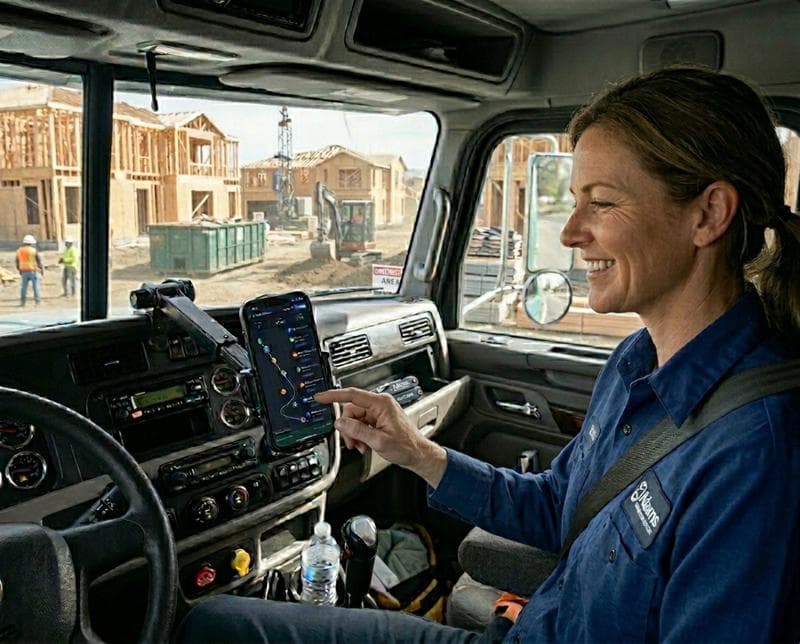
A modern driver app sends automatic status updates to dispatch and directly to customers without anyone having to make a phone call. When a driver marks a stop as complete in the app, your system can immediately SMS the customer: "Your bin was picked up at 10:47 AM. Ready for next week." This transparency reduces customer support tickets by an estimated 30-40% because people know exactly when service happened. Drivers no longer have to report in verbally; they tap a button, and the whole operation sees it in real-time.
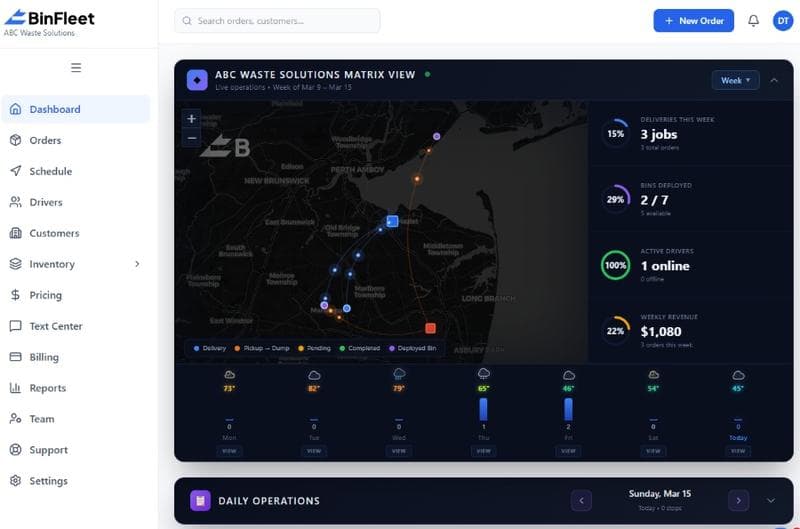
This also gives dispatch instant visibility into what's actually happening on each route. If a driver is running 45 minutes behind, the dispatcher can see it on the map and adjust expectations for the next scheduled stop or offer a pro-active customer update without guessing. For multi-yard operations, this real-time layer of data means your office team can make smarter decisions about whether to pull another truck into service or hold back based on actual productivity, not hunches or delayed radio chatter.
Photo Documentation and Proof of Service
Every dispute—"you didn't pick up my bin" or "you damaged my property"—comes down to one question: what proof do you have? A driver app forces documentation at the moment of truth. Before marking a stop complete, the driver takes a photo of the bin location, condition, and sometimes a before/after of the service. That photo is timestamped, geotagged, and stored in your system forever. If a customer claims you never showed up, you pull the photo, and the conversation ends. If a bin was damaged before pickup, the photo proves it wasn't your truck.
This paper trail also protects your drivers. A driver can't be falsely accused of damage or negligence if there's photographic evidence. It shifts the liability conversation from he-said-she-said to factual records. Insurance companies and legal teams appreciate this layer of documentation, and it often means lower liability claims or faster resolution when disputes do happen. In high-touch or high-value accounts, this capability becomes a selling point—you're the waste hauler who can prove every job.
Reducing Missed Stops and Route Inefficiency
Missed pickups are a silent revenue killer and customer satisfaction nightmare. They happen because a driver couldn't find the bin, the customer moved it, or communication broke down. A driver app can include customer notes ("bin is behind the building, not on street"), a photo of the actual location, and even turn-by-turn navigation to the exact GPS coordinates. When drivers have this context before arriving, missed stops drop significantly. They also know in real-time if a stop is a no-access situation—a locked gate or customer request to skip that week—so they can mark it and move on instead of wasting 15 minutes figuring it out.
Route efficiency improves when drivers can confirm every stop is completed and ready for the next one, all without returning to the depot to sync paperwork. Modern driver apps integrate with dispatch routing software, so drivers see optimized stop sequences right on their phone. If traffic or a delayed stop reshuffles the day, the app can dynamically update the route, keeping drivers on the fastest path instead of following a printed sheet that's outdated by noon. This means more stops per day per driver, lower fuel costs, and faster overall service delivery.
Integrations That Actually Work
A driver app isn't useful if it lives in isolation. The best systems integrate with your dispatch software, billing platform, customer management system, and accounting tools. When a driver completes a stop in the app, that data flows automatically into your billing system—no double entry, no data loss, no delays in invoicing. Customer history syncs to the driver's phone, so they can see billing status, notes from previous interactions, and any special instructions before they even arrive at the site.
For operations running multiple yards or managing subcontractors, integrations become essential. A centralized driver app means all teams are using the same reference data, the same customer info, and the same real-time updates. One driver app working across five locations is far simpler to manage than five separate tools or spreadsheets. See how BinFleet integrates dispatch, driver apps, and billing in one platform, so your whole operation speaks the same language.
Adoption and Training: Why Drivers Actually Use It
Some waste haulers worry that drivers won't adopt mobile apps—that older workers or tech-averse teams will resist the change. In practice, when apps are simple and save drivers time, adoption is fast. A good driver app shouldn't require a manual or IT support. Tap "arrive," take a photo, tap "complete." Done. Compare that to writing notes on a paper sheet, stopping at the office to hand it in, and waiting for billing to re-enter the data. The app is faster and easier, especially when drivers can see that it reduces their paperwork at the end of the shift.
Training is also lighter than expected. Most drivers understand the concept in under 15 minutes. The key is letting them see the benefit: fewer customer complaints about "where's my pickup," fewer disputes, and a company that has their back when a customer makes a false claim. Once drivers realize the app creates a paper trail that protects them, they become advocates. By 2026, the workforce in waste hauling is younger and more mobile-native than it was five years ago—adoption barriers are lower than ever.
FAQ: Driver Apps for Waste Haulers
What happens if a driver loses signal or the app crashes?
Modern driver apps are designed to work offline. A driver can still mark stops complete, take photos, and record notes even without cell signal. Once connection returns, the app automatically syncs everything to your server. This means data doesn't get lost during a service call in a dead zone or if the phone restarts. Most systems also sync data multiple times per day or on a schedule, so the window of data loss is minimal.
Do drivers need new phones, or does the app work on what they have?
Good driver apps work on any modern smartphone—iPhone or Android—and don't require expensive equipment upgrades. Most haulers already have drivers with phones, so setup cost is minimal. The app itself is lightweight and won't drain battery significantly, even on an older device. Some companies provide a stipend or company phone, but it's not mandatory for the app to function well.
How does a driver app reduce customer complaints?
Real-time status updates mean customers know exactly when their bin is picked up, eliminating the uncertainty that drives support calls. Automatic photo documentation means disputes are resolved faster because you have proof. When customers can text your company and get an instant "your pickup happened at 10:30 AM" response, they feel heard and informed, which improves satisfaction even if the service window was longer than expected.
Can smaller haulers afford a good driver app?
Yes. Modern platforms like BinFleet offer driver apps as part of an all-in-one package that includes dispatch, routing, and billing. For smaller fleets (5-20 trucks), the cost per vehicle per month is often $50-150, which pays for itself through reduced missed pickups, faster billing, and lower customer support overhead. Many platforms offer free trials so you can test it with one route before committing.
Getting Started: The Next Step
If your waste hauling operation is still managing driver communication through radio, phone calls, and paper, a modern driver app isn't a luxury—it's a competitive necessity. The cost of not having one is hidden in missed pickups, billing disputes, customer churn, and dispatcher stress. The good news is adoption is fast, the ROI is clear, and the technology is mature. Request a demo to see how a driver app integrates with your dispatch and billing workflow, or read more about operational best practices for waste hauling teams. Start with a free trial on one route and measure the impact yourself.
Ready to Streamline Your Operation?
See how BinFleet AI helps waste haulers save time, cut costs, and grow.
Request a Free 30-Day TrialRelated Articles
How a Mobile Driver App Transforms Waste Hauling Operations
Driver Apps for Waste Haulers: How Mobile Technology Transforms Daily Operations