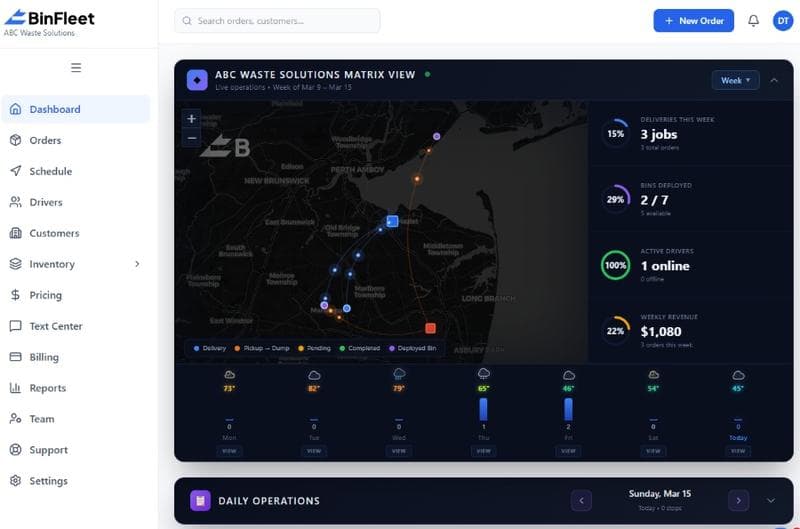
How a Driver App Transforms Waste Hauling Operations

Why Waste Haulers Need a Mobile-First Driver App
Paper routes and radio check-ins are relics of the past, yet many waste hauling operations still rely on them. Drivers spend time scribbling notes, calling dispatch to confirm stops, and leaving customers in the dark about arrival times. This friction costs real money—missed pickups, duplicate service calls, and unhappy customers who switch to competitors. A mobile driver app solves this by putting real-time job management in your driver's pocket, turning every stop into a documented, verifiable transaction.
The waste and recycling industry has changed faster than many operators have adapted. Today's drivers expect tools as intuitive as the apps they use in their personal lives, and customers demand SMS updates instead of guessing when the truck will arrive. A purpose-built driver app bridges this gap, syncing jobs from your dispatch system, capturing proof of service, and pushing updates automatically—no manual intervention required. The result is operational visibility that actually drives efficiency gains, not just dashboard metrics.
Real-Time Stop Management and Route Optimization
When drivers receive their daily route through a mobile app rather than a printed sheet or verbal briefing, they know exactly which stops come next, the order they're scheduled, and any special instructions for each location. The app can show customer contact info, service history, and container location—all without asking dispatch for clarification. This eliminates the downtime and confusion that happens when a driver arrives at a stop without full context, reducing callback delays and service errors that damage customer relationships.
Route optimization becomes smarter when every stop is tracked in real time. Dispatchers can see where each truck is, identify backups or missed stops within minutes, and reassign work before it becomes a service failure. Drivers can report traffic, mechanical issues, or customer access problems instantly, allowing dispatch to adapt the route on the fly rather than discovering the problem at the end of the shift. This dynamic responsiveness is especially valuable during peak seasons or when weather disruptions force rapid schedule changes.
Proof of Service Through Photos and Digital Capture
Photos are one of the most underutilized yet powerful tools in waste hauling operations. When a driver snaps a photo of a full dumpster, an overflowing roll-off, or damage to a container, that image becomes irrefutable proof of service—invaluable for billing disputes, customer clarification, and liability protection. A mobile app makes photo capture part of the natural workflow, allowing drivers to timestamp and geolocate images automatically, so there's no ambiguity about when or where the service occurred. This eliminates the "he said, she said" conversations that waste time and erode customer trust.
Digital capture extends beyond photos. Drivers can record notes about special conditions, confirm whether a customer was home, note blocked access points, or flag containers needing maintenance—all within the app. These notes sync instantly with dispatch and back-office systems, so office staff never wonder what actually happened at a stop. The result is cleaner billing, fewer disputed invoices, and a paper trail that protects your company in contract negotiations or customer complaints.
SMS Updates and Customer Communication
Customers hate uncertainty more than they hate waiting. A 15-minute arrival window message sent automatically when a driver is five stops away eliminates customer anxiety and reduces missed-access complaints. A mobile driver app can trigger these SMS updates based on actual location and progress, not estimated time. When a driver marks a stop complete, the customer receives instant confirmation—no separate call or email needed. This automation runs in the background while your driver focuses on the job, improving customer satisfaction without adding work.
Two-way communication also becomes possible. If a customer's contact info is displayed in the app, the driver can text questions directly—"Is there access to the dumpster today?" or "The bin is damaged, can we schedule a replacement?"—without radioing dispatch. Dispatch can push urgent messages to drivers in real time if a scheduled stop has been cancelled or rescheduled. This removes communication bottlenecks that typically slow service recovery when problems arise.
Integration with Your Dispatch and Back-Office System
A standalone driver app is only half the solution. The real power emerges when the mobile experience connects seamlessly with your dispatch software, billing system, and inventory management. Jobs created in your order management system automatically populate the driver's app the morning of service. Photos and completion notes feed back to billing, so invoicing reflects what actually happened, not what was scheduled. Container movements are recorded in real time, so your inventory always reflects accurate location and condition.
This integration eliminates manual data entry—the hidden cost killer in most waste hauling operations. When your driver app and dispatch platform talk to each other, information flows in one direction only, reducing transcription errors and the hours wasted reconciling conflicting records. BinFleet, for example, unifies driver mobile management with route optimization, customer communication, and invoicing in a single platform, so every part of your operation runs on the same current information. This creates a foundation for genuine operational efficiency, not just digital theater.
Measuring Impact and Continuous Improvement
Implementing a driver app generates valuable operational data: average stop duration, completion times, repeat trips, and photo documentation rates. This data reveals inefficiencies that are invisible in purely manual operations. You might discover that certain routes consistently miss their time window, or that specific customers always have access issues. With these insights, you can adjust pricing, resequence routes, or add proactive customer communication before problems escalate. The app becomes a continuous improvement tool, not just a task manager.
Driver adoption is critical to success, and a well-designed mobile app removes friction rather than adding it. Drivers who see faster route completion, reduced callback delays, and positive customer feedback become advocates for the tool. Tracking adoption metrics—photo capture rates, message response times, stop completion accuracy—helps you identify training gaps and celebrate quick wins. Over time, a driver app becomes embedded in your operational culture, making it hard to imagine working without the visibility and accountability it provides.
Common Questions About Driver Apps for Waste Hauling
What if my drivers don't have smartphones or data plans?
Most modern waste haulers provide smartphones as part of the job, similar to providing a two-way radio. Data plans are inexpensive (often $20–30 monthly per device) and far cheaper than missed pickups or inefficient routes. If you're concerned about coverage in remote areas, a good driver app works offline and syncs data when the truck returns to yard Wi-Fi, so connectivity gaps don't stop the operation. BinFleet's app includes offline functionality, meaning drivers can still access their route, capture photos, and record notes without constant internet connection.
How long does it take to train drivers on a new app?
A well-designed driver app should take 15–30 minutes to learn, not hours. Most waste haulers invest one training session per driver and follow up with quick reference cards or short video tutorials. The learning curve flattens quickly because the app mirrors the driver's actual workflow—you're automating what they already do, not asking them to learn a completely new process. Support from your software vendor (live chat, email, or phone) helps smooth the transition and builds driver confidence.
Can a driver app really reduce my operational costs?
Yes, but the payoff varies by operation size and baseline efficiency. Typical benefits include 5–15% reduction in duplicate service calls, faster billing cycles (fewer disputes to resolve), and route time savings of 10–20 minutes per day per truck. A 20-truck operation running 250 days per year saves roughly 1,000 hours annually—equivalent to 0.5 full-time positions. Read more about real ROI metrics from waste hauling operations to see what similar companies have achieved.
What happens to the data my driver app collects?
Data ownership and security are critical. Your driver app should be hosted by a vendor that complies with industry security standards and your local data regulations. Look for vendors offering automatic backups, encrypted transmission, and customer data ownership guarantees—not vendor lock-in. The data your drivers collect belongs to your company and should be portable, so you can run reports, export history for audits, or move platforms if your needs change.
Getting Started with a Driver App in 2026
The waste hauling market has matured enough that you have real choices. Evaluate driver apps based on three criteria: Does it integrate with your existing dispatch system? Can drivers and dispatchers actually use it intuitively? Will the vendor support your growth without surprise pricing increases? A pilot program—running the app on 2–3 trucks for 30 days—is a low-risk way to test compatibility with your operations before full rollout.
The best time to invest in mobile management is before you need it. Operational visibility, customer communication, and data-driven decision-making are no longer competitive advantages—they're baseline expectations. A mobile driver app positions you to meet those expectations while building the infrastructure for growth. Request a BinFleet demo to see how other waste hauling operators are managing routes, capturing proof of service, and improving profitability with a unified mobile platform.
Ready to Streamline Your Operation?
See how BinFleet AI helps waste haulers save time, cut costs, and grow.
Request a Free 30-Day TrialRelated Articles
How a Mobile Driver App Transforms Waste Hauling Operations
Driver Apps for Waste Haulers: How Mobile Technology Transforms Daily Operations