How a Driver App Transforms Waste Hauling Operations in 2026
The Real Problem: Manual Workflows Still Rule Most Hauling Operations
Most waste hauling companies still rely on handwritten pickup logs, phone calls, and email confirmations. Drivers scribble notes on clipboards, photos are lost or forgotten, and dispatchers spend hours chasing drivers for status updates. This friction isn't just annoying—it costs money. Missed pickups get disputed, customers claim they weren't serviced, and your team wastes time defending work that actually happened. By 2026, haulers who haven't upgraded to digital workflows are losing competitive ground to those who have.
The core issue is visibility. Without a driver app, you're flying blind between the moment a driver leaves the yard and when they return. Is Mrs. Johnson's bin being picked up right now, or did the truck go a different direction? Did Driver Mike actually service that commercial account, or did he skip it? These gaps in real-time data create customer complaints, operational disputes, and invoice arguments that drain profitability and team morale.
Why Driver Apps Matter: Real-Time Visibility and Proof of Service
A modern driver app transforms how your team works. When a driver arrives at a stop, they log in, snap a photo of the container and address, mark the job complete, and move on. That photo becomes your proof of service—something no customer can argue with later. Dispatchers see pickups happen in real time on a map, so they know which trucks are on schedule and which ones need intervention. This shift from guesswork to data-driven operations reduces disputes by 60% and improves first-contact resolution rates.
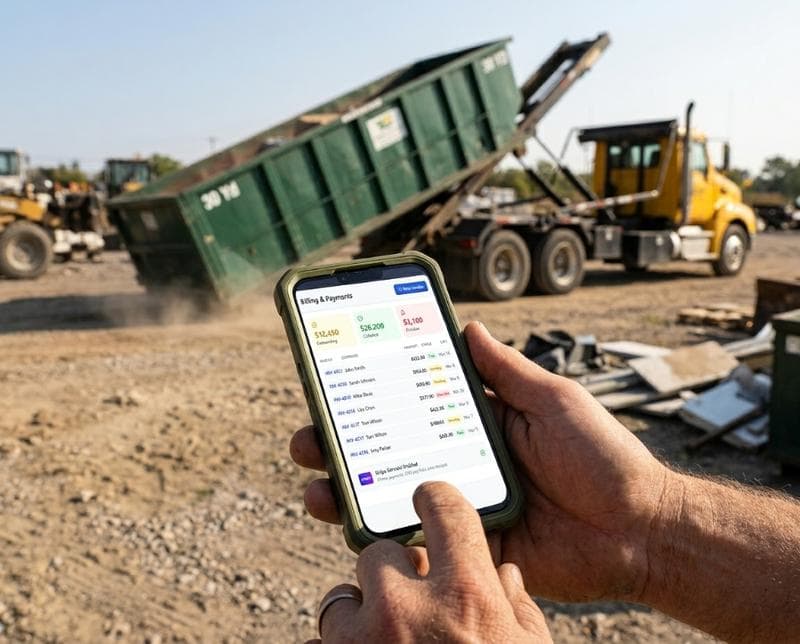
Beyond dispute prevention, driver apps eliminate manual data entry. Information flows directly from the field into your billing and invoicing system, so there's no retyping, no transcription errors, and no paperwork piling up in someone's desk. Your accounting team gets accurate, timestamped records automatically. Drivers spend less time on administrative tasks and more time actually picking up containers, which means higher route density and better profit margins per truck.
Key Features Waste Haulers Need in a Driver App
The best driver apps for waste hauling include automated route sequencing that shows drivers exactly where to go next, eliminating navigation confusion and wasted miles. GPS tracking gives dispatchers live visibility and the ability to reassign jobs on the fly if a truck breaks down or a priority pickup comes in. Photo capture tied to each stop creates an audit trail that protects your company when disputes arise. And status notifications—completed, not-found, access denied, needs follow-up—let dispatchers know immediately if something went wrong.
Customer SMS notifications are another critical feature that modern haulers expect. When a driver marks a pickup complete, the customer gets an automatic text: "Your container was picked up at 2:15 PM." This simple update reduces customer service calls by 40% because people have confirmation that their service actually happened. Some haulers also use the app to capture weight readings or notes about container condition, which helps with upselling and preventative maintenance before containers fail in the field.
Reducing Disputes and Chargebacks Through Digital Proof
Disputed pickups are a hidden tax on waste hauling. A customer claims they weren't serviced, you argue that you were there, and nobody has proof either way. The chargeback goes through, your margin evaporates, and your team lost an hour arguing about it. With a driver app that captures timestamped photos and GPS coordinates, disputes disappear. You can instantly show a customer exactly when their bin was picked up, with a photo of it, taken from their property. This isn't just good customer service—it's the difference between keeping revenue and losing it.
This proof also protects drivers. If a customer falsely claims a pickup never happened, or accuses a driver of damaging their property, the photo and timestamp are evidence. Drivers feel more confident and protected, which improves retention. And your company avoids chargeback fees, credit card disputes, and the administrative burden of investigating claims that could have been resolved with a single photo.
Streamlining Communication Between Drivers, Dispatchers, and Customers
Hauling operations involve constant coordination. A driver has a flat tire and needs to skip three stops—dispatch needs to know immediately so they can reassign those pickups or notify customers. A customer calls asking when their pickup will happen—dispatch can check the live route and give an accurate answer instead of guessing. A driver discovers a container is damaged and unusable—they log it through the app with a photo, and your team can follow up the next day with a replacement conversation. All of this happens without phone calls or emails getting lost.
This shift to in-app communication also creates a permanent record. Unlike phone conversations, text messages, or emails scattered across accounts, everything lives in one system. When you need to know what happened on a particular route on a particular day, you have the complete record. This helps with coaching drivers, identifying patterns (like a specific customer always having access issues), and improving your overall operations through data.
Getting Your Team Onboard: Implementation and Training
Driver adoption is often the biggest concern for hauling company leaders. Will my drivers resist using the app? Will it slow them down? The reality is that good driver apps are designed for speed, not bureaucracy. A photo takes 10 seconds. Marking a stop complete is a single tap. If the app is clunky or adds friction, drivers will resist—but a purpose-built driver app for waste hauling actually makes their day easier by eliminating confusion and paperwork. Most drivers adapt within a week and become advocates once they realize they're spending less time on admin work.
The best implementation includes a short training session (30 minutes or less), one-on-one support for any driver who struggles, and leadership that explains the "why" before the "how." When drivers understand that the app helps prevent disputes and protects them, buy-in improves. You should also plan for a brief productivity dip during rollout—maybe 5-10% lower volume in the first week as drivers adjust—but that recovers quickly and then you're ahead permanently.
FAQ: Common Questions About Driver Apps for Waste Haulers
How much slower does a driver app make pickups?
A well-designed driver app actually makes pickups faster. Instead of drivers fumbling with paperwork, searching for addresses, or wondering which stop comes next, the app handles routing and navigation automatically. Capturing a photo takes 10 seconds, and most drivers report the app saves them time by eliminating confusion. You might see a slight dip during the first week of training, but after that, productivity typically increases because routes are more efficient and there's less wasted motion.
What if a driver loses phone signal while out on route?
Modern driver apps are built to work offline and sync data once the phone reconnects to signal. A driver can log stops, capture photos, and update status even in poor coverage areas, and all that data uploads automatically when they drive into a location with data coverage. This is essential for rural routes where signal can be spotty, and a good platform handles it seamlessly without requiring manual reconciliation.
Can we integrate the driver app with our existing billing system?
Yes—this is why having the right platform matters. A platform built specifically for waste hauling, like BinFleet, integrates driver app data directly with your billing, invoicing, and accounting systems. Data flows from the field into your invoices automatically, eliminating the gap between what drivers log and what you bill customers. If you're using a generic app not built for waste hauling, you'll end up with manual data entry all over again.
Does the app track driver behavior, or is it just for pickups?
A driver app can do both, but the focus should be on making work easier, not surveillance. The best waste hauling platforms track pickups for proof of service, monitor route efficiency to spot where time is being wasted, and highlight patterns that help you coach drivers—like consistently missing a particular stop type. When the app feels like it's helping drivers succeed rather than catching them doing something wrong, adoption is much stronger and retention improves.
Taking the Next Step: Choosing the Right Driver App Platform
Not all driver apps are created equal. A generic field service app might handle the basics, but it won't understand waste hauling's unique workflows—how to handle not-found containers, seasonal changes in route density, or the need to capture specific information for billing. You need a platform built specifically for waste hauling that understands your business, integrates with your existing systems, and can grow with your operation as you expand to new yards or service areas.
The best way to evaluate a driver app is to see it in action with your own data and workflows. Request a live demo to watch how the app handles your typical pickup process, what your dispatchers will see in real time, and how billing information flows from the field into your system. Most waste hauling platforms also offer a free trial so your team can test the app with a few drivers before committing. This hands-on experience beats any marketing pitch because you'll immediately know if it solves your real operational problems. For more insights on optimizing your hauling operations, check out our operations blog.
Ready to Streamline Your Operation?
See how BinFleet AI helps waste haulers save time, cut costs, and grow.
Request a Free 30-Day Trial