How a Driver App Transforms Waste Hauling Operations in 2026
The Real Cost of Manual Workflows on Your Drivers
Every day your drivers spend time managing paperwork, writing notes, and communicating status changes through phone calls or text chains costs you money and frustration. A driver with a smartphone knows something is wrong—but without a structured way to report it, the message gets lost, delayed, or misinterpreted. When a container is damaged, locked gate blocks access, or a customer isn't home, delays cascade across your schedule and create customer confusion.
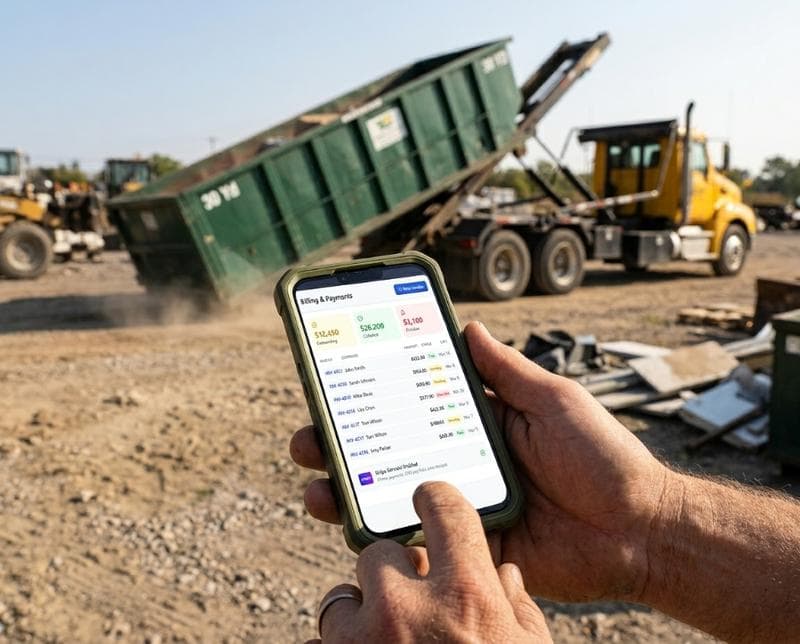
Manual stop management also creates liability gaps. If a driver damages a property or a customer disputes service, you have no timestamped photo evidence or digital record of what happened. Dispatchers spend hours tracking drivers down by phone, and drivers interrupt their routes to answer questions they should be able to report instantly. A driver app solves this by putting the tools directly in the driver's hands—proof of work, real-time status, and instant communication built into one mobile interface.
Photo Documentation: Your Legal Shield and Quality Proof
Capturing photos at each stop isn't just nice to have—it's your protection against false damage claims and your proof that work was completed correctly. When a customer calls to say a container was already damaged, or a neighbor disputes that your crew was even there, a timestamped photo with GPS data settles the argument. A driver app makes this effortless: snap a photo of the container before and after service, tag it to the job, and it's instantly stored with location and time metadata.
This digital trail also raises service quality. Drivers know their work is being documented, which encourages care and attention to detail. If a dumpster is placed at an odd angle or left blocking a driveway, the photo tells the story before a complaint comes in. Over time, this reduces damage claims, customer disputes, and the administrative burden on your office staff. Many haulers using driver apps report a 30-40% reduction in disputed service calls within the first three months.
Real-Time Status Updates: Keeping Customers and Dispatchers Aligned
Traditional waste routes run on guesswork. A dispatcher schedules a pickup at 2 PM, but has no idea if the driver is stuck in traffic, dealing with a full container, or at the wrong address. Customers call asking where their order is, and the dispatcher can only shrug. A driver app with real-time GPS and status updates transforms this chaos into visibility. Drivers tap a button to mark a stop as complete, flag a problem, or indicate they're running late—and that information updates the dispatch board and can trigger automated customer notifications.
This transparency eliminates the need for constant phone calls. Instead of a driver having to call dispatch about a locked gate or missed address, they report it in the app, dispatch adjusts the route, and the customer gets an SMS update automatically. The entire team—driver, dispatcher, and customer—stays on the same page. Response time to problems drops from hours to minutes, which means fewer missed stops and fewer angry customers.
Reducing Driver Friction and Retention
Drivers appreciate tools that make their job easier and faster. Forcing them to call in status updates, remember stop details, or chase down paperwork at the end of the day creates frustration and drives turnover. A driver app removes that friction. They clock in at the start of their route, navigate to stops using built-in GPS, complete each stop with a photo and notes, and hand off their day—no chasing dispatch, no missing information, no follow-up calls from the office asking for details.
This efficiency also means drivers can complete more stops per shift when they're not wasting time on communication and administrative tasks. A driver who spends 15 minutes per stop on phone calls and paperwork loses nearly two hours per eight-hour shift. That's 25% of productive time gone. With a driver app, those tasks take 60 seconds total. Drivers see higher earnings potential, feel supported by technology rather than hindered by it, and stay longer in their roles. Retention improves, training costs drop, and your operation runs smoother.
Integration: Connecting the Driver App to Your Whole Operation
A driver app only reaches its potential when it's connected to your dispatch system, inventory management, and customer communication tools. When a driver marks a stop as complete in the app, it should automatically update your yard inventory, trigger an invoice, and send the customer a photo confirmation. When dispatch changes a route, the driver's app should reflect that instantly without manual intervention.
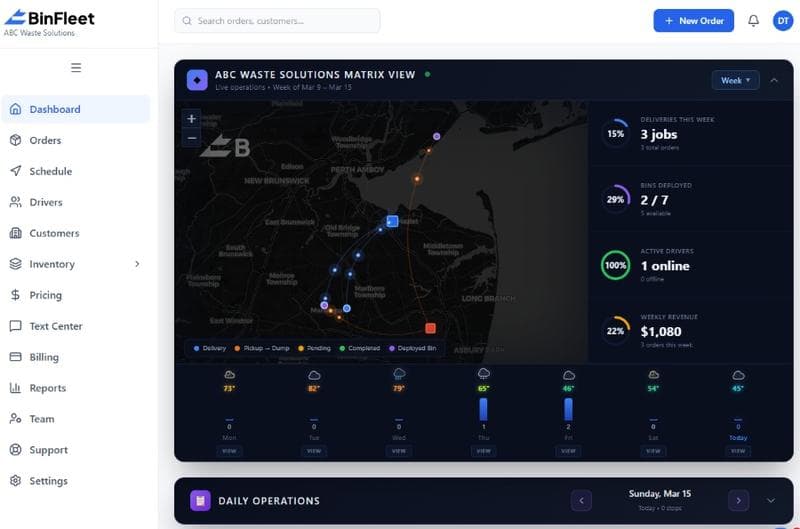
This integration eliminates data re-entry and sync errors. Your office team isn't copying stop information into separate systems, invoicing manually, or trying to match photos to customer accounts hours later. Everything flows together: BinFleet AI, for example, connects driver apps with route optimization, inventory tracking, payment processing, and customer SMS updates in one platform. A single source of truth means faster invoicing, fewer disputes, and less administrative overhead.
Choosing and Implementing a Driver App in 2026
Not all driver apps are built for waste hauling. A generic delivery app designed for parcel services won't understand dumpster dimensions, weight capacity, or the specific workflows of container-based businesses. Look for an app that speaks your language: designed by waste industry operators, not just software engineers. It should be intuitive enough that drivers adopt it without extensive training, fast enough to work on older phones with spotty signal, and reliable enough that a bug doesn't strand a driver mid-route.
Implementation matters too. Rolling out a new app to your entire fleet at once is risky; a phased approach with a pilot group of 3-5 drivers lets you work out issues before full deployment. Set clear expectations with drivers about what the app replaces and what new workflows they'll follow. Provide on-site training and maintain a point person they can call with questions. Within 2-3 weeks, most drivers will be comfortable. After 30 days, you'll see measurable improvements in stop completion time, photo documentation, and dispatch response speed.
FAQ
Do drivers really use mobile apps, or do they resist the change?
Resistance is real at first, but it fades quickly when drivers see the app makes their job easier. If a driver spends 20 minutes less on paperwork and communication each shift, they feel the benefit immediately. Resistance typically comes from drivers who are forced to use a clunky app or receive poor training. Pick an intuitive app designed for their workflow, train them properly, and provide support—most teams reach 90%+ adoption within one month.
What happens if a driver's phone dies or they lose signal?
A well-designed driver app works offline. Drivers can still complete stops, add photos, and log notes without data connection. When they regain signal, everything syncs automatically. This is essential for rural routes or areas with poor coverage. Test your app's offline capabilities before deployment to ensure it won't leave drivers stranded or unable to document their work.
How much does a driver app cost, and is it worth the investment?
Pricing varies widely, but a driver app as part of an integrated platform typically runs $15-40 per month per vehicle. The ROI comes from reduced administrative labor, faster invoicing, fewer disputed claims, and improved driver efficiency. Most haulers recoup the investment within three months. Request a free trial or demo with any platform you're considering to validate the value before committing.
Can a driver app integrate with our existing dispatch system?
Integration depends on your current system and the app you choose. Modern platforms like BinFleet AI are built as integrated suites with driver apps, dispatch, inventory, and billing all connected. If you're using legacy systems, look for apps with API connections or integration partners. The more integrated your stack, the smoother your workflow and the higher your ROI.
Take the Next Step
A driver app isn't a luxury anymore—it's the foundation of a modern waste hauling operation. It reduces friction for drivers, gives dispatchers real visibility, and creates the proof of service that protects your business. If you're managing stops with phone calls and paperwork, you're leaving efficiency on the table. Request a demo with BinFleet AI to see how integrated driver apps, dispatch, and customer communication work together. Or start a free trial to experience the workflow transformation firsthand.
Ready to Streamline Your Operation?
See how BinFleet AI helps waste haulers save time, cut costs, and grow.
Request a Free 30-Day TrialRelated Articles
How a Mobile Driver App Transforms Waste Hauling Operations
Driver Apps for Waste Haulers: How Mobile Technology Transforms Daily Operations