How Driver Apps Streamline Waste Hauling Operations
Why Waste Haulers Need a Dedicated Driver App
Your drivers spend their entire day in the field—jumping between 20, 30, or 40+ stops—yet they're often working with outdated tools. Pen-and-paper manifests, unclear GPS, and no way to send photo proof until the job is done create gaps that cost time, cause customer complaints, and make invoicing headaches. A mobile driver app closes these gaps by putting the entire operation in your driver's pocket, letting them confirm stops, capture images, and update dispatch in real time. This isn't convenience; it's operational necessity in 2026.
The financial impact matters too. When a driver can't quickly confirm a pickup was completed or prove a dumpster swap happened, you lose credibility with customers and face disputed invoices. Delays cascade—one missed photo becomes three customer service calls becomes one angry customer telling five others to use your competitor instead. A solid driver app eliminates that friction by making every stop accountable, transparent, and documented instantly.
Real-Time Stop Confirmation and Route Optimization
Modern driver apps let your team confirm arrivals, start jobs, and mark stops complete with a single tap. GPS integration automatically logs location, so you know the driver actually visited the customer—no false stops, no shortcuts. When a driver marks a stop complete with a timestamp, that data flows straight to dispatch and accounting, eliminating manual entry and the errors that come with it. This real-time visibility means you can also spot problems early: if a driver is running two hours behind, you know immediately and can notify customers proactively instead of letting them guess.
Route optimization becomes smarter when you have live driver data. Your dispatch team can see which stops are taking longer than planned, which roads are congested, and where inefficiencies hide. Some driver apps integrate with mapping engines to suggest better sequences on the fly, saving fuel, reducing overtime, and getting drivers home earlier. This data also builds historical patterns—after a few weeks, you'll see that residential pickups in the north end consistently take 3 minutes longer than you estimated, so you can adjust future scheduling accordingly.
Photo Proof and Compliance Documentation
Taking photos on a smartphone is easy; having a system that organizes, links, and stores them with the right stop is completely different. A purpose-built driver app lets your team snap photos of container conditions before pickup, damage during the job, and final placement after delivery—all tagged automatically with the stop, time, and location. These photos sync to your office immediately, creating an instant audit trail that protects your business if a customer disputes a charge or claims a container arrived damaged. When a homeowner says "your driver never showed up," you have a timestamped photo proving otherwise.
Compliance becomes simpler too. Environmental agencies, local waste regulations, and liability insurance often require documented proof of proper handling. A driver app that automatically links photos to specific jobs means you're never scrambling through folders trying to match images to pickups. Audits move faster, disputes settle easier, and your team demonstrates professionalism that justifies your rates. This kind of accountability also reduces liability claims—you've got visual proof of how containers were handled and positioned.
Instant Customer Communication and Status Updates
Customers increasingly expect to know when their service is happening. A driver app that sends automated SMS or app notifications when the truck is on the way transforms the customer experience. Instead of customers watching the clock and wondering if they'll be home, they get a message five minutes before arrival with the driver's name and vehicle details. This reduces no-shows and callbacks because customers actually know to put the bins out or be ready. For residential and commercial routes, that's the difference between smooth handoffs and frustrated customers calling dispatch mid-route.
Status updates also reduce phone tag. Dispatchers spend less time answering "where's my pickup?" calls when customers can see live progress in real time. Your team fields fewer interruptions, drivers stay focused on the route, and customers feel informed and valued. This kind of transparency is now table stakes in waste hauling—competitors who offer it will steal your customers if you don't.
Integration with Dispatch, Billing, and Inventory
A driver app isn't useful in isolation; it needs to talk to your dispatch system, accounting software, and container inventory management. When a driver marks a stop complete and uploads photos, that data automatically triggers the next logical steps: updating the customer's account, flagging the container for maintenance if damage was noted, and queuing the invoice for processing. This integration eliminates the admin work that slows down your back office, so your office team spends less time copying data and more time solving problems or chasing collections.
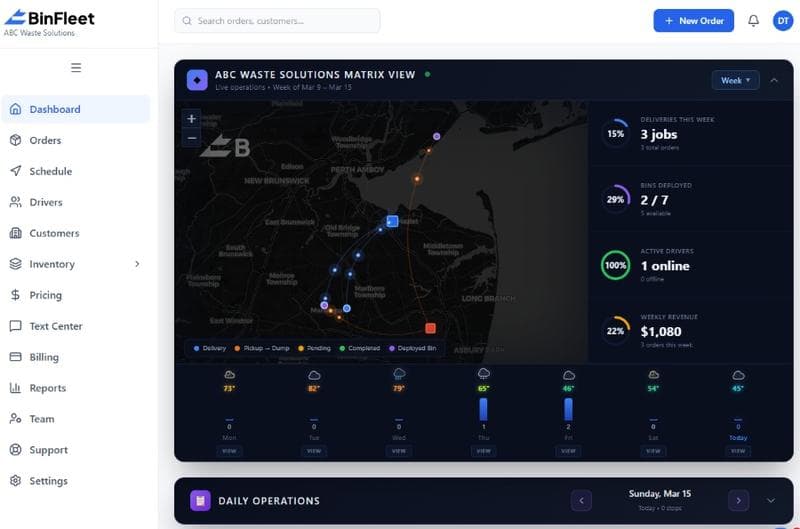
Inventory accuracy improves dramatically when driver apps sync directly with your container tracking system. If a driver swaps a damaged container with a clean one, they can update the inventory status immediately, so dispatch always knows which containers are actually on hand. This prevents overbooking, reduces emergency swaps, and helps you right-size your fleet. A platform like BinFleet integrates all these systems so data flows seamlessly from driver to dispatcher to accountant without manual handoffs.
Reducing Paperwork and Manual Data Entry
Paper manifests and post-route data entry belong in the past. Every minute a driver or office person spends transcribing stops, times, or photos into a computer is wasted time and a chance for errors. A driver app captures data once, in the field, where it's accurate and timely. Timecard disputes disappear because stop timestamps are logged automatically. Route efficiency calculations become accurate because you're not relying on driver estimates. Invoicing speeds up because the job details are already in your system before the driver returns to base.
The cumulative time savings across a team of 5, 10, or 20 drivers is substantial—easily 5 to 10 hours per week of office work eliminated. That's time your team can spend on customer retention, route optimization, or spotting revenue leaks. And beyond time savings, accuracy improves costs too: fewer invoice disputes, fewer missed charges, and fewer service errors mean higher margins and happier customers.
Choosing the Right Driver App for Your Operation
Not all driver apps are built for waste hauling. Many generic delivery apps don't understand the nuances of container management, recycling options, or multi-service billing. A purpose-built solution should include stop confirmation, photo capture, GPS verification, customer notifications, and seamless integration with your dispatch and accounting systems. It should work on older smartphones (many drivers don't have brand-new devices) and function in areas with spotty cell coverage. Test any app on your actual routes and vehicles before committing to make sure it performs in real-world conditions, not just in the demo.
Consider ease of use too. If the app is confusing or slow, drivers will resist using it or use it incorrectly, defeating the purpose. The best driver apps are intuitive enough that new hires get productive on day one without extensive training. Look for vendors who provide ongoing support, regular updates, and a clear roadmap for features you'll need. A quick demo of a platform built specifically for waste haulers will show you the difference between generic delivery software and purpose-built solutions.
FAQ
Do driver apps work without internet or cell signal?
Most modern driver apps cache jobs and maps locally, so drivers can operate offline during their route. Once they reconnect to cellular or WiFi, data syncs to the office automatically. This approach works well for rural or mixed-coverage areas where signal is intermittent rather than completely absent. Before adopting any app, test it on your actual service routes to ensure it handles your coverage patterns.
How do driver apps reduce customer complaints about missed or late stops?
Real-time notifications let customers know the truck is on the way, so they're prepared and fewer surprises occur. GPS verification also gives you proof if a customer disputes whether a service happened, eliminating he-said-she-said conflicts. Plus, dispatch can proactively alert customers of delays instead of letting them guess, which dramatically improves satisfaction even when issues do happen.
Can a driver app integrate with my existing billing and dispatch software?
Most modern driver apps connect via APIs to popular dispatch and accounting platforms. If you use older legacy systems, integration may be limited—something to discuss with vendors upfront. Reading case studies on our blog shows how other haulers successfully integrated driver apps with their existing workflows. A platform designed as an all-in-one solution (dispatch, billing, driver app, customer portal) eliminates integration headaches altogether.
How quickly do driver apps pay for themselves?
The payback typically comes from reduced office staff time, fewer billing disputes, fewer missed charges, and improved route efficiency. Many haulers see $3,000 to $8,000 in monthly savings within the first few weeks, depending on fleet size and current processes. Better customer retention and the ability to scale without proportionally increasing admin overhead add even more value over time.
Getting Started with Driver Apps in 2026
The waste hauling industry has evolved beyond paper routes and late-day data entry. Driver apps are now essential to competitive operations—they improve customer experience, protect your business with proof-of-service documentation, and free your team from paperwork. The question isn't whether to adopt a driver app anymore; it's which one fits your operation best. Start with a platform built specifically for waste haulers, one that understands your billing models, container management, and dispatch complexity. See how your team works with the tool before committing to a long-term contract.
If you're ready to streamline your operation, schedule a free demo to see how a purpose-built system brings driver apps, dispatch, billing, and customer communication together in one place. Your drivers will work smarter, your office will work faster, and your customers will feel the difference.
Ready to Streamline Your Operation?
See how BinFleet AI helps waste haulers save time, cut costs, and grow.
Request a Free 30-Day TrialRelated Articles
How a Mobile Driver App Transforms Waste Hauling Operations
Driver Apps for Waste Haulers: How Mobile Technology Transforms Daily Operations