How a Driver App Transforms Waste Hauling Operations
Why Drivers Need a Mobile App—Not Just GPS
Most waste haulers rely on GPS routing alone, but that solves only half the problem. Drivers still juggle paper manifests, miss stop details, forget to photograph damaged containers or spills, and can't update customers until the end of the day. This fragmented workflow leads to billing errors, customer complaints about missed pickups, and dispatch supervisors without real-time visibility into what's happening on the road.
A purpose-built driver app connects each stop to the specific customer details, container types, and photos that actually matter. When a driver can see the exact location of a commercial dumpster, confirm the weight category, and snap a compliance photo—all from their phone—the whole operation tightens. No more miscommunication between drivers and office staff, no more surprises at invoicing time.
Stop Management: The Core of Driver Efficiency
Every stop on a waste route involves multiple decisions: which container to pick up, what weight it is, whether it needs a replacement, and whether the customer has special instructions. Without a driver app, this information lives in a dispatcher's notes or—worse—nowhere. Drivers guess, skip steps, or call back to ask basic questions, costing 5–10 minutes per stop.
A mobile app displays each stop with all relevant data before the driver arrives: customer name, container type, weight limit, special handling notes, and even past service history. Drivers can mark each stop complete, record weight if they have on-board scales, and flag issues instantly. This transforms stops from chaotic guesswork into a structured, traceable process that reduces errors and cuts wasted time significantly.
Photo Capture: Proof That Protects Your Business
Disputes over billing, damage claims, and compliance violations happen because there's no visual record of what the driver actually saw. A customer claims they never had an extra bin; a driver denies they spilled debris. Without photos, your company assumes the liability and loses credibility.
A driver app with built-in photo capture lets operators document every significant event: bin condition before pickup, spillage or damage, customer property, and proof of service. These timestamped photos sync to the office in real-time or queue automatically when service returns. In 2026, when regulatory scrutiny and customer expectations keep rising, photo documentation is no longer nice-to-have—it's essential insurance against disputes and compliance failures.
Real-Time Status Updates: Keep Customers Informed
Customers hate uncertainty. They schedule their business around your arrival window but have no way to know if you're running 30 minutes late. This leads to calls flooding your office, drivers distracted by angry voicemails, and reputational damage that's hard to measure but easy to feel.
A driver app enables automatic or manual status updates sent directly to customers—arrival alerts, in-progress notifications, and completion confirmations. Some platforms even integrate SMS or push notifications, so customers get real-time transparency without your team lifting a finger. This single feature dramatically reduces call volume, improves customer satisfaction, and lets drivers focus on the work instead of handling repeat inquiries.
Route Optimization Meets Driver Accountability
Route optimization software can cut drive time by 15–20%, but only if drivers actually follow the optimized sequence. Many drivers default to their familiar patterns or make real-time adjustments that sound logical but undermine the plan. Without a driver app tied to routing, you lose accountability and waste the investment in optimization.
A mobile driver app displays the optimized sequence, shows which stops have been completed, and provides real-time feedback when deviations occur. Dispatchers can see immediately if a driver is off-route and understand why—weather, a mechanical issue, or a priority customer request. This transparency helps operations managers distinguish between bad decisions and legitimate exceptions, enabling fair performance reviews and continuous improvement.
Integration With Your Dispatch and Billing System
A standalone driver app solves today's problem but creates a new one: data silos. Driver photos, stop confirmations, and weight readings live on the app, but your billing, inventory, and dispatch system don't talk to each other. Your office team re-enters data manually, creating delays and errors that undermine the whole efficiency gain.
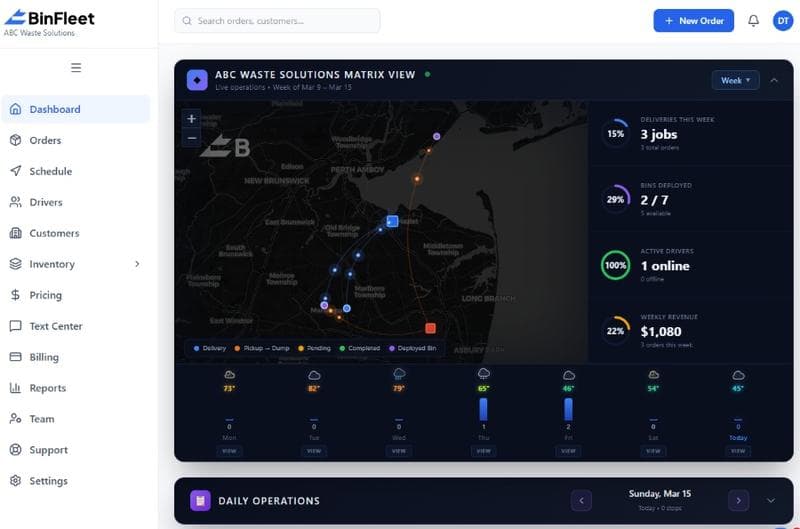
The best driver apps are built as part of an end-to-end waste management platform. BinFleet, for example, connects driver mobile actions directly to dispatch dashboards, invoicing workflows, and customer management. When a driver marks a stop complete with a photo in the app, that data automatically flows to billing, customer records, and fleet analytics. This eliminates double-entry, speeds up invoicing by days, and gives you real operational intelligence instead of scattered data points.
FAQ: Driver Apps for Waste Haulers
What happens if a driver loses cell service during a route?
Modern driver apps are built for field conditions. They work offline, queuing photos, confirmations, and location data locally. When the driver regains signal—usually within minutes—everything syncs automatically to your cloud system. No data loss, no missed stops, no downtime. The app should handle weak or intermittent connectivity gracefully, which is why you need a solution designed for waste hauling, not generic field service software.
How much training do drivers need to use a new app?
Most drivers adopt a well-designed app in 1–2 days because it mirrors their existing workflow—pull up to stop, do the job, mark it done, move on. Bad apps require extensive training and cause resistance. Look for an app with an intuitive interface, clear icons, and minimal friction. Your vendors should provide onboarding videos and in-app guidance. Training time is an investment that pays back within the first week through reduced errors and faster stops.
Can a driver app work with different types of containers and services?
Yes, the best driver apps are flexible. They handle residential pickups, commercial dumpsters, roll-off service, and specialized waste streams without requiring separate platforms. The app should let you customize stop types, weight categories, photo requirements, and customer communication templates. When you expand services or change how you manage certain container types, the app should adapt without expensive re-implementation or vendor involvement.
How do I know if drivers are actually using the app correctly?
Your dispatch and operations dashboard should show adoption metrics: stop completion rate, photo compliance, average stop time, and route adherence. Compare these metrics week-over-week to see if driver behavior is improving. Also track customer feedback and billing accuracy—these are the real outcomes that matter. If photos are being submitted, stops are marked on time, and your invoicing errors drop, drivers are using the tool correctly and it's delivering value.
Getting Started With Driver Apps in 2026
The waste industry in 2026 is moving fast. Customers expect visibility, drivers want tools that make their job easier, and operators need data they can trust. A driver app that handles stops, photos, and real-time updates isn't a nice-to-have luxury anymore—it's becoming table stakes for competitive waste hauling companies.
If you're managing routes with spreadsheets, phone calls, and manual data entry, a modern driver app will feel like a revelation. You'll see stops completed faster, fewer billing disputes, better customer satisfaction, and finally, real visibility into what's happening on your routes. The best way to understand the impact is to see it in action. Most platforms, including BinFleet, offer free trials or demos so you can test it with real routes before committing. Start small, measure results, and expand as confidence grows. For more on optimizing waste operations, check out our blog for waste hauling best practices.
Ready to Streamline Your Operation?
See how BinFleet AI helps waste haulers save time, cut costs, and grow.
Request a Free 30-Day TrialRelated Articles
How a Mobile Driver App Transforms Waste Hauling Operations
Driver Apps for Waste Haulers: How Mobile Technology Transforms Daily Operations