How to Track and Reconcile Dump Fees Across Multiple Facilities
The Real Cost of Manual Dump Fee Tracking
Most waste hauling operations still reconcile dump fees the way they did fifteen years ago: spreadsheets, email confirmations, and manual data entry. A dispatcher logs a load, the driver drops it off, the facility sends an invoice weeks later, and someone in the office spends hours matching records and hunting for discrepancies. By then, billing errors have already cost you money, customer invoices went out with wrong amounts, and nobody knows which fees were actually passed through to clients.
The problem compounds when you work with multiple landfills, transfer stations, or recycling centers. Each facility has different fee structures, minimum charges, and billing cycles. One charges by weight, another by volume, a third has a flat drop fee. Drivers don't always report loads accurately at the gate, facilities don't always record what was actually dropped, and your invoicing system doesn't talk to their data. The result is a $5,000 to $20,000 annual leak in most mid-sized operations—money you're legally owed but never collected because the trail went cold.
Why Dump Fee Reconciliation Breaks Down
Reconciliation failures usually stem from three sources: data silos, timing gaps, and human error. Your dispatch system knows a load was scheduled, your weighing scale knows the tonnage, the facility's gate system knows when it arrived, and your accounting software needs to bill the customer. But none of these systems talk to each other. Information gets typed into multiple places, versions diverge, and by the time someone notices a mismatch, the invoice is already in the customer's hands or the landfill's bill was paid out of the operating account without a trace.
Timing gaps make it worse. A load might be picked up on Monday, dropped Tuesday morning, invoiced by the facility on Friday, but your internal records don't update until the following week. Customer calls to dispute their bill because they have different numbers than you do. Your driver swears he dumped three loads but only two appear on the facility invoice. Reconciliation becomes detective work, not accounting. The longer this lag persists, the harder it is to audit and the more likely you'll just absorb the loss to keep the customer relationship intact.
What Dump Fee Tracking Software Does Right
Proper dump fee tracking software integrates directly with facility gate systems, your dispatch platform, and your invoicing engine. When a driver completes a drop-off, the facility's system automatically records weight, material type, date, and charges. That data flows into your operations platform in real time or within hours, not weeks. Your system cross-references it against the dispatch record and the driver's report. Discrepancies surface immediately—a 500-pound difference, a missed surcharge, a duplicate billing. You can investigate and correct it before the customer is ever billed.
The best platforms let you set up rules for each facility's fee structure: override certain charges, apply volume discounts, flag unusual patterns, and route fees to the correct customer account. If a client has negotiated a capped dump fee, the system knows to stop accumulating charges once the threshold is hit. If another facility adds a $15 hazmat surcharge, the system applies it automatically to the right loads. You're no longer manually adjusting invoices after the fact. Every customer gets billed accurately on the first attempt, and your cash flow improves because you're capturing revenue that previously slipped through the cracks.
Streamlining Multi-Facility Operations
Waste haulers with operations across multiple counties or regions face an especially complex reconciliation puzzle. One landfill is two hours north, another is south, and a third is an independent facility with its own accounting department and billing schedule. Without a centralized tracking system, your office staff needs to manually reconcile data from three different sources, each with its own format, fee structure, and billing frequency. You end up with spreadsheets that don't sync, invoices that don't match disposal records, and arguments with customers about what they actually owe.
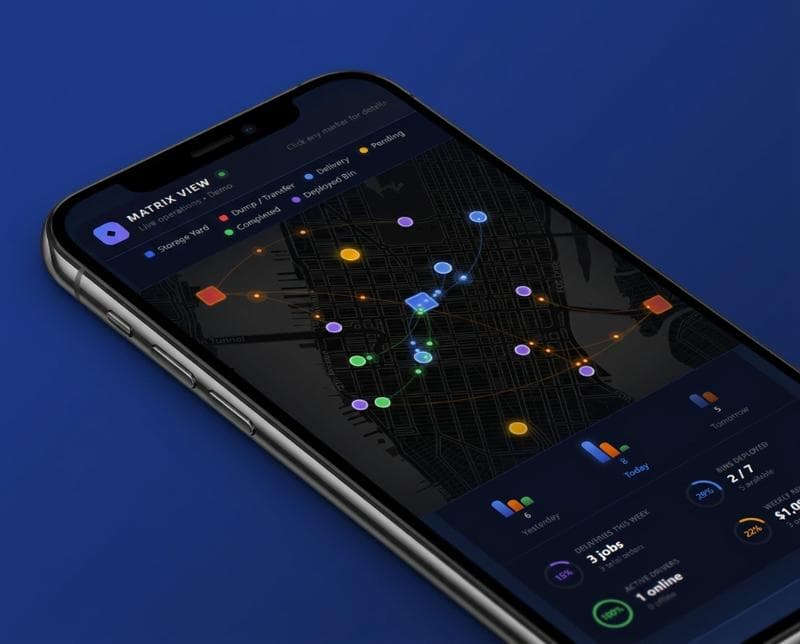
Dump fee tracking software centralizes all of this. You log into one dashboard and see every load, every facility, every charge across your entire operation. You can drill down into a specific facility, a specific day, or a specific customer to audit the chain of events. Reports show you which facilities are most expensive, which are fastest to turn around, which generate the most billing errors. This visibility lets you make better decisions: maybe you shift volume to a cheaper facility, negotiate better rates with high-volume centers, or identify drivers who consistently misreport tonnage. See how BinFleet handles multi-yard tracking in a live walkthrough.
Compliance and Audit Readiness
Regulators and large customers increasingly demand proof of proper disposal. You need to show that a contaminated load went to the right facility, that hazardous waste was handled according to law, that everything was documented and tracked. If you're operating on spreadsheets and email confirmations, you're one audit away from scrambling to prove you didn't break the law. Dump fee tracking software creates an immutable audit trail: who picked up the load, where it went, what the facility recorded, when it was billed, when it was paid. Every step is timestamped and linked to the original dispatch and driver records.
This documentation is also essential for customer disputes. When a client calls and says their invoice is wrong, you can pull up the exact facility receipt, show the weight recorded at the gate, point to the fee schedule you both agreed to, and explain the math. You're not making excuses or offering a partial refund to keep the peace. You're showing facts. In cases where you discover you actually did overbill, the audit trail lets you correct it quickly and maintain trust. For waste haulers working with commercial clients or municipalities, this credibility is worth thousands annually.
Integration With Your Existing Workflow
The best dump fee tracking tools don't require you to rip out your current dispatch and billing systems. They integrate with what you already use—your routing software, your accounting platform, your customer portal. Your drivers keep using the dispatch app they know. Your office staff keeps using their invoicing system. Behind the scenes, the tracking software silently ingests facility data, compares it to your records, flags problems, and feeds corrected information back into billing. You get the benefit of automated reconciliation without the chaos of switching systems mid-year.
Implementation is quick because most of the work is configuration, not custom coding. You set up rules for each facility, define which customer gets billed for which loads, and tell the system how to handle edge cases. Within a few days, the software is running in parallel with your manual process, catching errors you never saw before. Once you're confident in the data, you flip it live. Read our implementation guide for waste operations to see how other haulers made the transition.
Real Savings and ROI
What's the actual financial impact? Most waste haulers see revenue recovery of three to five percent within the first year. That means if you're dumping 100 tons per week at $45 per ton, you're moving $234,000 annually through disposal facilities. A three percent recovery is $7,020 in previously lost revenue. The system also reduces the time your office staff spends on reconciliation—typically five to ten hours per week in medium-sized operations—freeing them to focus on higher-value work like customer retention or pricing analysis.
There's also a reduction in billing disputes because customers get accurate invoices the first time. You spend less time on phone calls, credit adjustments, and goodwill gestures. Your cash flow improves because you're billing faster and more accurately. In industries where margins are tight, this kind of efficiency gain is the difference between a breakeven year and a profitable one. Most waste haulers recoup the cost of dump fee tracking software within six to twelve months.
FAQ: Common Questions About Dump Fee Tracking
How quickly does dump fee data flow from the facility into my system?
Most facilities update their records within a few hours of a drop-off, and the best tracking software syncs that data within the same day, sometimes in real time. If you're working with a facility that still uses manual gate operations, the lag might be overnight. Either way, it's infinitely faster than waiting for a paper invoice to arrive in the mail.
What happens if a facility's fee structure changes or they add new surcharges?
You update the rule in your tracking software, and it applies retroactively to any loads that haven't yet been invoiced to customers. The system can flag loads affected by the change so you can review them before sending bills. This prevents the nightmare scenario where you invoice old loads under new rates or miss applying a new surcharge.
Can the software integrate with multiple facilities that use different systems?
Yes, that's the whole point. Modern dump fee tracking software connects to facilities via API, EDI, email data feeds, or even CSV uploads, depending on what each facility supports. You're not locked into one facility's technology. Your software sits in the middle and translates everything into a common format your business understands.
What if my customer disputes a charge because they think the weight reported is wrong?
You pull up the facility's gate receipt, which is a third-party document they can't argue with. If there's a genuine error on the facility's side, you work with them to correct it. If the customer suspected contamination caused extra handling fees, the software shows exactly which loads incurred those charges and why. Disputes get resolved faster because you have data, not opinions.
Take the Next Step
If you're spending more than a few hours per week on dump fee reconciliation, or if you know you're leaving money on the table because of billing errors, it's time to look at a purpose-built solution. Dump fee tracking software is not a luxury—it's a necessity for any multi-facility operation. The math is simple: a few thousand dollars in software costs you five figures in recovered revenue and hundreds of hours of freed-up labor.
Want to see how it works? Schedule a quick demo with our team, or start with a free trial of BinFleet to track a few loads and watch the system catch discrepancies your manual process has been missing. Most waste haulers are shocked at what they discover in the first week.
Ready to Streamline Your Operation?
See how BinFleet AI helps waste haulers save time, cut costs, and grow.
Request a Free 30-Day Trial