How to Outperform Competitors in Dumpster Rental & Waste Hauling
Understanding Your Competitive Landscape in 2026
The dumpster rental market has fundamentally shifted. Five years ago, a company with a fleet, a phone line, and a notebook could compete. Today, customers expect real-time SMS tracking, online booking, transparent pricing, and same-day or next-day delivery—and they'll switch providers in seconds if you can't deliver. Your competitors aren't just other local haulers anymore; they're aggregator platforms, tech-native startups, and regional chains with sophisticated dispatch systems. Understanding who you're up against isn't a one-time exercise; it's an ongoing intelligence operation that shapes your service model, technology investments, and pricing strategy.
The winners in 2026 are operators who see competitive advantage through three lenses: operational efficiency, customer experience, and pricing intelligence. You can't win on price alone if your delivery times are slow or your customers feel like they're talking to a 1990s business. Similarly, premium service means nothing if you're losing money on every job or if your dispatch system has drivers sitting idle for hours between calls. The companies gaining market share right now are those balancing all three—and they're using software like BinFleet to do it systematically, not heroically.
Analyzing Competitor Pricing Without Losing Your Margin
Price transparency has become a competitive weapon. Most customers now check three to five providers before calling, and they want to see pricing online instantly. If your competitors publish rates and you don't, you've already lost credibility. But publishing rates doesn't mean dropping prices to match every competitor; it means pricing strategically based on your cost structure, service speed, and local demand. Start by documenting what your top three local competitors charge for standard sizes (10, 20, 30-yard bins) and common add-ons like junk removal, same-day delivery, and overage fees. Then map those prices against your own delivery costs, driver wages, fuel, equipment maintenance, and landfill or disposal fees in your region.
The insight isn't in matching prices—it's in understanding the gaps. If a competitor is offering free delivery on every order, they're either absorbing the cost, targeting only high-density areas, or they'll raise prices after getting you as a customer. If another operator charges $50 more than you for the same bin size but maintains higher customer retention, they're probably winning on service speed or customer communication. Many successful haulers in competitive markets are actually charging premium rates while increasing volume by offering faster dispatch, transparent pricing, and better customer service. The goal is to move upmarket slightly rather than race to the bottom; this protects your margin while building a reputation for reliability.
Service Speed as a Competitive Differentiator
Delivery time is no longer a courtesy—it's a selection criterion. In dense urban and suburban markets, customers routinely choose between a same-day bin and a next-day bin, and they'll pay 10–20% more for same-day. This represents a genuine competitive advantage if you can deliver it reliably. The challenge is that same-day delivery only works with smart routing, driver availability, and real-time order management. A dispatcher working from a spreadsheet and checking a flip phone can't execute same-day commitments at scale. This is where modern dispatch software creates a tangible edge: it shows you available capacity, optimal routes, and realistic delivery windows instantly, letting you confidently promise what you can actually deliver.
Competitors who invest in dispatch optimization are also reducing their cost per delivery, which strengthens their pricing position without sacrificing margin. When your routes are optimized, drivers spend less time driving between jobs, which means more deliveries per shift, better fuel efficiency, and happier drivers who aren't exhausted by inefficient days. Companies using real-time dispatch platforms report 15–25% reductions in travel time and 10–15% improvements in deliveries per day. Those aren't minor gains; they're the difference between surviving and thriving in a competitive market. Customers feel this difference immediately: faster delivery, accurate arrival windows, and SMS notifications build confidence and loyalty.
Building Loyalty Through Superior Customer Experience
Price-shoppers are fickle, but customers who trust you are sticky. The companies gaining customer lifetime value are those making the entire experience frictionless: simple online booking, transparent pricing with no surprise fees, proactive communication, and professional service. A customer who can book a 20-yard bin online, receive a SMS confirmation with the driver's arrival window, get real-time updates when the truck is five minutes away, and then receive an invoice and feedback request—without a single phone call—is experiencing a different service tier than someone calling a dispatch line and waiting on hold. That experience is repeatable, defensible, and hard for competitors to copy quickly because it requires both systems and culture change.
Loyalty also compounds with reviews and referrals. If your competitor is faster but less professional, and you're professional but slower, you'll lose that customer once. But if you're faster and professional, that customer becomes an evangelist—they'll recommend you to neighbors, contractors, and business owners. Online reviews and Google Maps ratings now influence 60–70% of new customer decisions in many markets. A competitor with higher ratings and more reviews (even at a slightly higher price) will consistently win against a cheaper provider with mediocre reviews. Building this advantage requires deliberate customer service processes, follow-up systems, and often a platform that makes it easy to capture feedback and respond to reviews promptly.
Technology as Competitive Moat
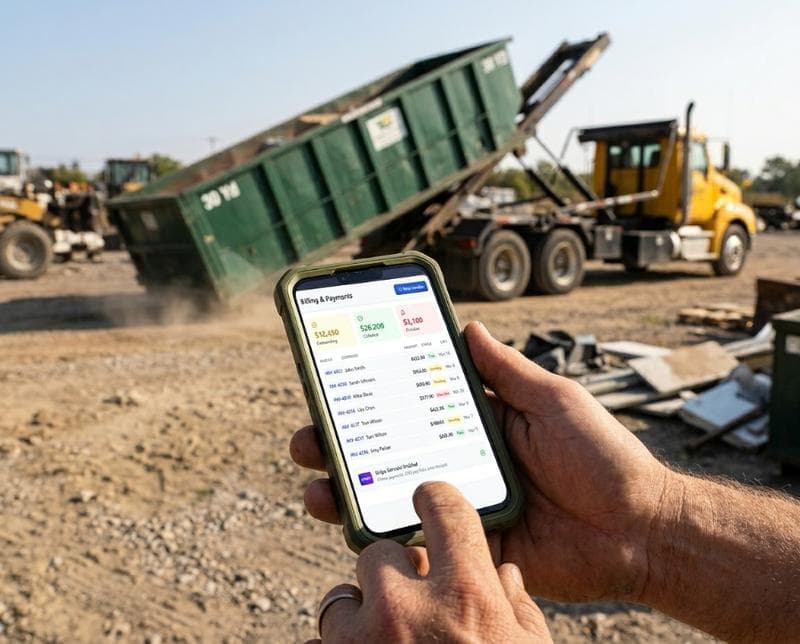
The operators pulling ahead in 2026 are using software not just as a backend tool but as a competitive feature. Customers can see where their bin is, pay online before pickup, and track their account history. Dispatchers manage all operations from one screen instead of juggling calls, emails, and notebooks. Drivers spend more time earning money and less time on administrative tasks. This integrated approach—what leading platforms like BinFleet's dispatch solutions enable—creates efficiency that's hard for competitors to replicate if they're still using outdated systems or pen-and-paper methods. Technology investment also attracts better talent; skilled dispatchers and operations managers want to work with modern tools, and that improves overall execution.
More importantly, software gives you data. You can see which services are most profitable, which routes are most efficient, which customer segments have the best retention, and where demand is growing. Competitors relying on intuition or informal notes can't react as quickly to market shifts. A data-informed operator can quickly adjust pricing for high-demand times, allocate equipment to growing areas, and identify upsell opportunities. Over time, this compounds into a structural advantage: you're not just faster and cheaper than competitors; you're systematically smarter.
Building a Sustainable Competitive Edge
Short-term competitive moves—a price cut, an aggressive marketing campaign—are visible to competitors and easy to counter. Sustainable advantages come from systems, culture, and talent. Invest in training your team so customer service is consistently excellent, not dependent on one great employee. Build routing and dispatch processes that genuinely optimize for speed and efficiency, not just reduce paperwork. Make pricing intelligent and customer-facing, not arbitrary and hidden. When you combine these practices with software that scales them, you create a competitive moat that's expensive and time-consuming for others to replicate. A competitor can copy your price for a week; they can't quickly copy your dispatch optimization, team culture, or customer service reputation.
The waste and dumpster rental business is moving toward a model where service, transparency, and technology are table stakes. The winners will be those who invest in all three systematically. If you're still running operations on spreadsheets and making pricing decisions reactively, now is the time to evolve. See how modern dispatch software can transform your operation and give you a real competitive edge.
FAQ: Competitive Strategy for Waste Haulers
How do I know if I'm priced competitively?
Get quotes from five competitors in your service area for your most common bin sizes and service add-ons. Compare their prices to your own, then calculate what margin you make on each service after all direct costs. If competitors are 15–20% cheaper and you can't match that while maintaining profit, focus on differentiating through faster delivery or better service rather than cutting price. If they're only 5–10% cheaper, pricing might be your opportunity, but first audit whether your cost structure is truly optimized.
Can I compete against larger regional chains?
Yes, but not on their terms. Large chains have scale and brand recognition, but local operators often win on responsiveness, personalized service, and flexibility. They can commit to same-day delivery in specific neighborhoods, adjust pricing quickly, and build real relationships with contractors and businesses. The key is choosing a narrow geographic focus where you can dominate rather than trying to compete everywhere.
What's the fastest way to improve customer retention?
Ask your customers directly why they'd recommend you (or wouldn't). The answer is usually service speed, professionalism, or pricing—and it's often not what you think. Then focus improvement efforts on that gap. Most haulers improve retention faster with better communication and reliability than with price cuts, because customers care most about predictability and respect for their time.
Should I discount aggressively to win new customers?
Aggressive discounts attract price-sensitive customers who'll leave as soon as someone else discounts more. Instead, offer a small first-time discount (10–15%) that's profitable, but compete primarily on speed and service quality. Customers gained through quality are more profitable long-term and more likely to refer others.
Ready to Streamline Your Operation?
See how BinFleet AI helps waste haulers save time, cut costs, and grow.
Request a Free 30-Day Trial