How a CRM System Transforms Dumpster Rental Customer Retention
The Hidden Cost of Poor Customer Data Management
Most dumpster rental companies track customer information across scattered spreadsheets, email threads, and driver notes. When a longtime customer calls with a complaint, the dispatcher may not know about a recurring billing issue from three months ago or that the account manager promised a loyalty discount. This fragmentation doesn't just frustrate customers—it costs you revenue. Studies show that 68% of customers leave businesses because they feel undervalued, and in the waste industry, that translates directly to losing recurring monthly contracts that should be predictable profit.
A dedicated CRM for dumpster rental consolidates every customer touchpoint in one searchable database. Service dates, pickup requests, equipment swaps, payment history, and past service issues live in one place where any team member can access them instantly. When a customer calls, your dispatcher already knows their account status, recent interactions, and service preferences before the conversation starts. This visibility alone shifts the dynamic from reactive problem-solving to proactive relationship management—and customers notice the difference immediately.
Tracking Service History to Prevent Customer Churn
Churn in dumpster rental happens quietly. A customer's bin sits full on a Friday because a pickup got missed, so they call a competitor on Monday. Or they received a surprise overage charge they didn't understand, felt nickeled-and-dimed, and quietly switched providers. Without a CRM, these incidents get logged in someone's memory, not in a system. By the time you realize the account is gone, it's gone. A robust CRM tracks every service interaction—on-time pickups, late deliveries, quality issues, and customer feedback—creating a transparent record that helps you catch deteriorating relationships before they become cancellations.
The revenue impact of retention is enormous. Acquiring a new dumpster rental customer costs three to five times more than keeping an existing one. A CRM that flags accounts showing warning signs—fewer pickups, late payments, or unresolved complaints—lets you intervene with a service credit, a call from management, or a rate adjustment before they leave. Operations managers who use CRM data to monitor account health report 15-25% improvements in customer retention within six months, directly protecting monthly recurring revenue.
Automating Follow-Ups and Building Loyalty
Manual follow-up is impossible at scale. Dispatchers are managing routes, drivers are in the field, and office staff are juggling phones and invoicing. Important customer communications slip through cracks. A CRM automates the touchpoints that build loyalty: service confirmations, pickup reminders via SMS, payment alerts, and post-service surveys. When a customer sees a confirmation text before their pickup, they feel cared for. When they get a reminder that their account needs attention, they don't get blindsided by a service disruption. These small touches, multiplied across dozens or hundreds of accounts, compound into stronger customer relationships and higher net retention rates.
Loyalty also grows when customers see value in the relationship. A CRM lets you identify your best accounts—highest frequency pickups, longest tenure, best payment behavior—and recognize them with exclusive offers, priority service, or referral bonuses. You can also segment customers by service type (residential, commercial, construction) and send targeted communications that feel relevant rather than generic. Personalization at scale, powered by CRM data, transforms a transactional business into a partner your customers want to keep.
Using Customer Data to Grow Revenue Per Account
Most dumpster rental operators leave money on the table by not understanding their customers' evolving needs. A CRM tracks usage patterns, seasonal variations, and customer inquiries over time. If a customer's pickup frequency has doubled over six months, they may be ready for a larger container or an additional unit. If a construction customer has consistently upgraded to premium bins, they're a candidate for a higher-margin service package. If a business account has never used your recycling service, a simple recommendation backed by data from similar accounts can unlock new revenue without any acquisition cost.
Revenue growth also comes from reducing friction in the sales cycle. When a prospective customer inquires, a CRM captures the lead details, tracks follow-up attempts, and ensures no opportunity falls through the cracks. For existing customers considering upsells or service add-ons, the CRM preserves the context of previous conversations, so your sales team can build on past discussions rather than starting from zero. See how BinFleet consolidates customer data and service workflows to make every interaction count toward growth.
Integration with Dispatch and Operations
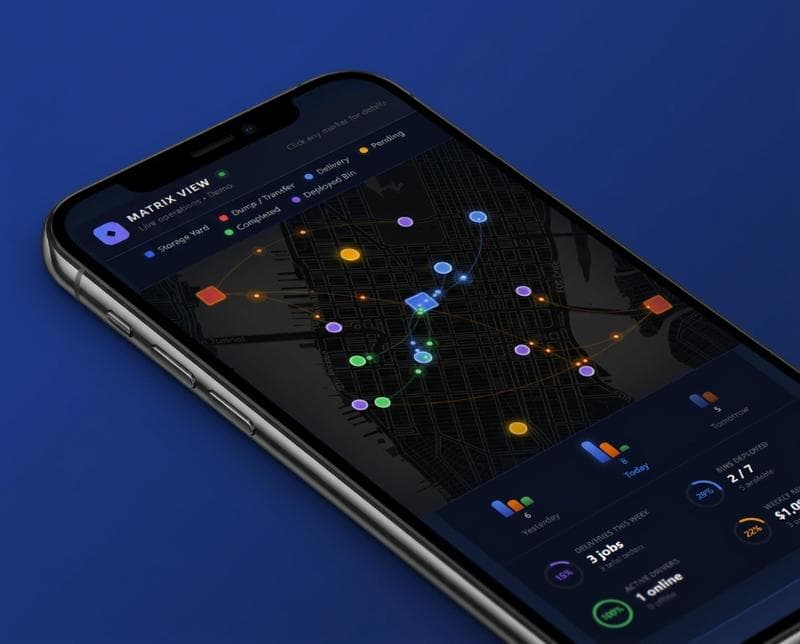
A CRM for dumpster rental only works if it connects seamlessly to your dispatch, billing, and inventory systems. When customer data lives in a separate silo, it becomes stale and unreliable. The best solutions integrate customer profiles with real-time pickup scheduling, billing records, and equipment tracking. Dispatchers see customer notes while assigning routes. Drivers get delivery instructions and special requests on their mobile app. Billing automatically reflects service customizations and loyalty adjustments. This integration eliminates manual data re-entry, reduces errors, and ensures every system sees the same truth.
For multi-yard operations, integration is non-negotiable. A customer may interact with multiple yards, place orders through different channels, and receive service from different teams. Without a unified CRM, each yard manages its own customer relationships in isolation, losing the opportunity to provide consistent service and cross-sell opportunities across the network. BinFleet's platform unifies customer data, dispatch, and billing across all your locations, so customers get one seamless experience regardless of which yard serves them.
Measuring What Matters: CRM Metrics That Drive Decisions
Not all CRM activity is equally valuable. What matters is measuring metrics that directly affect profitability: customer lifetime value, churn rate, repeat service intervals, and revenue per account. A CRM that doesn't report on these metrics is just a contact database. The best systems give you dashboards showing which accounts are growing, which are at risk, and which segments generate the highest margins. You can see how often a typical customer uses your service, how long they stay with you, and what services they purchase most frequently. These insights guide resource allocation—where to focus retention efforts, which customer segments are most profitable, and where to hire and train.
Measurement also holds your team accountable. When account managers can see which customers they've successfully retained versus lost, they improve their performance. When dispatchers understand which service metrics correlate with retention, they prioritize reliability. When leadership sees the revenue impact of CRM adoption—fewer cancellations, larger average order values, more service add-ons—they justify continued investment in the platform and supporting processes.
FAQ: Common Questions About CRM for Dumpster Rental
Do I need a CRM if I only have 50-100 customers?
Yes. Many operators assume CRM is only for large enterprises, but the real benefit appears as soon as you have more accounts than your team can hold in memory. With 50+ customers, you're already losing visibility into service history and relationship status. A CRM grows with you—it prevents bad habits now and scales smoothly as you add customers later. Learn how operators of all sizes use CRM to improve retention.
What's the difference between a generic CRM and one built for waste management?
Generic CRMs like Salesforce are designed for sales teams managing prospects. They don't understand dumpster rental workflows like equipment swaps, recurring pickups, or the relationship between drivers, routes, and customer service. A waste-specific CRM embeds industry knowledge—tracking container inventory, managing service territories, and integrating with dispatch systems. This specialized fit means faster adoption, fewer manual workarounds, and better data quality out of the box.
How long does it take to see ROI from a CRM?
Most operators see measurable improvements within 30-60 days: fewer missed pickups because of better notes, faster customer service responses because data is centralized, and reduced churn as you begin proactive outreach. Significant revenue gains—from improved retention and upsells—typically appear within three to six months once the team is trained and using the system consistently. The key is adoption; a CRM only works if your team actually uses it.
Can I integrate my existing billing and dispatch software with a CRM?
Most modern CRM platforms offer APIs and pre-built integrations with popular billing and dispatch systems. However, integration quality varies widely. Before choosing a CRM, verify that it integrates with your current tech stack or that you're willing to migrate. Seamless integration is worth the effort upfront—it prevents duplicate data entry and keeps customer information accurate across all systems.
Start Managing Customer Relationships Like a Profit Center
Your customers are your most valuable asset, but they're only profitable if you retain them. A CRM designed for dumpster rental and waste hauling transforms how you track, serve, and grow customer relationships. Instead of hoping customers stay, you'll have visibility into their account health, a system for proactive retention, and data-driven opportunities for growth. The operators winning in 2026 aren't just moving bins—they're managing customer relationships strategically, and a CRM is the tool that makes it possible. Schedule a free demo to see how BinFleet's customer management features work, or explore how other waste operators are improving retention and revenue on our blog.
Ready to Streamline Your Operation?
See how BinFleet AI helps waste haulers save time, cut costs, and grow.
Request a Free 30-Day Trial