How a Dumpster Rental CRM Transforms Customer Retention and Revenue
Why Dumpster Rental Companies Need a CRM (Beyond Contact Lists)
Most dumpster rental operators think of CRM as a glorified Rolodex. In reality, a modern CRM built for waste services does something far more valuable: it captures the complete customer lifecycle, from first quote to repeat billing to expansion opportunities. When a dispatcher, office manager, or driver has real-time access to a customer's service history, payment patterns, container preferences, and communication notes, they can make smarter decisions that strengthen relationships instead of defaulting to transactional interactions.
The core problem is that many small and mid-sized rental companies rely on fragmented systems—a spreadsheet here, text message records there, loose notes in email. This fragmentation creates blind spots. You might not know that a customer had a negative experience three months ago, or that they're ready to add a second dumpster to their account. Without CRM visibility, you lose revenue opportunities and miss early warning signs of churn. A unified CRM platform consolidates customer data, communication history, and operational events into one source of truth.
Revenue Growth Through Better Customer Insights
When you can see every interaction a customer has had with your company—service dates, callbacks, complaints resolved, positive feedback—you gain the ability to identify upsell and cross-sell moments. A contractor who rents a 20-yard bin monthly might be ready for twice-weekly service during peak season. A retail store that uses a 10-yard container might need a temporary 30-yard drop for a renovation project. A CRM tracks these patterns and surfaces recommendations to your sales or account management team, turning routine service into revenue multiplication.
Beyond upselling, a CRM-driven approach to retention cuts churn dramatically. Studies across service industries show that companies with strong customer data retention strategies see 20–40% lower churn rates than those without. In dumpster rental, where margins are often tight and customer acquisition costs are high, keeping existing customers is far cheaper than finding new ones. A CRM lets you proactively reach out to at-risk customers with special offers, check in after service issues, and remind dormant accounts why they chose your company in the first place.
Operational Efficiency Meets Customer Experience
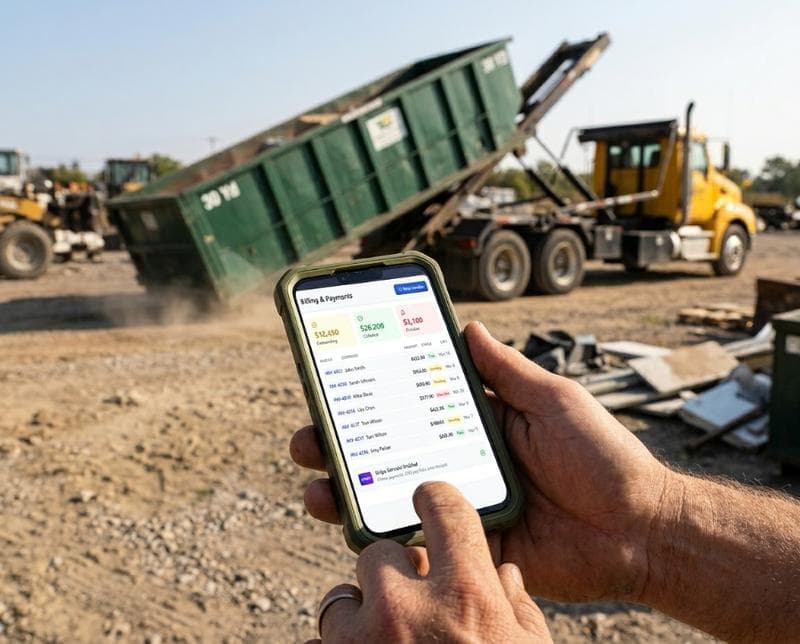
A CRM for waste hauling isn't confined to the sales or customer service office—it integrates with dispatch, billing, and driver operations. When a driver completes a service, that data flows into the CRM immediately, automatically triggering workflows like payment reminders, service confirmations via SMS, or quality-check follow-ups. This eliminates manual data entry, reduces errors, and ensures no customer query falls through the cracks. Dispatchers see customer preferences and special instructions without digging through five different systems, which speeds up scheduling and reduces mistakes.
The result is a seamless experience: customers receive timely confirmations, billing is accurate and transparent, and your team spends less time hunting for information and more time solving problems and growing accounts. When customers see that you remember their preferences, deliver consistently, and follow up professionally, they're far more likely to stay loyal and refer friends. That's the operational efficiency advantage of a CRM built specifically for waste and dumpster services.
Data-Driven Decision Making for Fleet and Pricing
A CRM isn't just a customer tool—it's a business intelligence engine. By analyzing CRM data, you can answer questions like: Which customer segments generate the highest lifetime value? What's our average contract length by region or service type? Which pricing strategies retain customers best? Which routes or container sizes are most profitable? These insights guide decisions about fleet investment, pricing adjustments, and service expansion. Without CRM data, you're making these decisions by gut feel, which often leads to wasted capital or missed opportunities.
For example, if your CRM reveals that month-to-month customers churn at double the rate of annual contracts, you can adjust your sales process to emphasize annual commitments, or offer incentives to convert short-term customers. If you see that large commercial accounts in a certain zip code are more profitable, you can target similar businesses in adjacent areas. Data-driven strategy compounds over time, turning small advantages into significant competitive edges.
Integration With Dispatch and Financial Systems
The best dumpster rental CRMs don't live in isolation—they're part of an integrated platform that speaks to your dispatch software, billing system, and invoicing tools. When these systems connect, you eliminate the double-entry and miscommunication that plague multi-system operations. A customer change—say, upgrading from weekly to twice-weekly service—updates seamlessly across CRM, dispatch, billing, and invoicing. Everyone works from the same playbook, and the customer sees consistent, professional execution.
This integration also makes it possible to automate routine tasks: sending invoices after service completion, flagging past-due accounts, scheduling maintenance reminders, or generating SMS updates to customers about their orders. Automation doesn't replace your team—it frees them to focus on high-value work like relationship building, problem-solving, and revenue growth. If you're still moving data between systems manually, you're burning time and introducing errors that hurt both customer satisfaction and your bottom line.
Building Long-Term Customer Loyalty and Lifetime Value
Customer loyalty in dumpster rental isn't about emotion—it's about consistency, reliability, and feeling heard. A CRM enables consistency by ensuring every team member knows the customer's history and preferences. It enables reliability by automating timely communications and service reminders. It makes customers feel heard by allowing you to track concerns, follow up on issues, and remember personal details that matter to them. Over time, these small interactions compound into deep loyalty and higher lifetime value.
When a customer knows you remember their peak season, adjust your service schedule accordingly, respond quickly to issues, and offer fair pricing based on their loyalty, they're unlikely to switch to a competitor for a 10% discount. They become promoters who refer other business to you. They expand their own usage and service tiers. They become the foundation of sustainable, profitable growth. A CRM transforms customers from one-time rentals into long-term partners, and that shift is the real source of competitive advantage in the waste services industry.
FAQ: Dumpster Rental CRM Questions
What's the difference between a generic CRM and one built for dumpster rental?
Generic CRMs like Salesforce are powerful but built for sales teams managing long sales cycles. A waste-specific CRM understands dumpster rental workflows: container tracking, dispatch integration, recurring billing, driver handoffs, and SMS customer updates. It's pre-configured for your business model, so you spend less time customizing and more time using it to drive results. See how BinFleet CRM works for waste operators.
How quickly will we see ROI from implementing a CRM?
Many operators see measurable results within 30–60 days: reduced administrative time, fewer missed follow-ups, and faster invoice processing. Revenue impact—from retention improvements and upselling—typically appears within 90–120 days as your team gets comfortable with the system and starts acting on CRM insights. The payback period depends on your current churn rate and average customer value, but most mid-sized operators recoup implementation costs within six months.
Will our drivers and dispatchers actually use a CRM?
Yes, if the CRM is designed for their workflow and reduces their workload. Modern dumpster rental CRMs use mobile apps, simple interfaces, and one-click actions that fit how drivers and dispatchers already work. When they see that the CRM saves them time and makes their jobs easier, adoption becomes natural. The key is choosing a platform built by people who understand waste operations, not a generic SaaS tool forced into your business.
Can a CRM help us manage multi-yard operations?
Absolutely. A centralized CRM gives you a unified view of all customers and operations across multiple yards, while letting each yard manager see only their relevant data. This enables consistency in customer service across locations, centralized billing and invoicing, and company-wide reporting on profitability and growth. Multi-yard operators especially benefit from CRM because it eliminates the silos that usually develop between locations.
Get Started With CRM for Waste Services
A CRM isn't a luxury—it's the operational backbone that separates growing, profitable dumpster rental companies from those struggling to scale. If you're managing customers through spreadsheets, text chains, and loose notes, you're leaving money on the table and creating risk. Modern CRM platforms built for waste hauling deliver customer insights, operational efficiency, and revenue growth without the complexity of generic enterprise tools.
The best way to understand whether a waste-specific CRM fits your business is to see it in action. Request a demo of BinFleet to see how the platform handles customer management, dispatch, billing, and reporting. If you want to explore more about optimizing operations, check out our blog on waste industry best practices, or visit our homepage to learn how thousands of waste operators are growing their businesses with better customer relationships and streamlined operations. Start your free trial today and see the difference a purpose-built CRM can make.
Ready to Streamline Your Operation?
See how BinFleet AI helps waste haulers save time, cut costs, and grow.
Request a Free 30-Day Trial