The Complete Dumpster Rental Insurance Guide for Waste Haulers
Why Dumpster Rental Businesses Need Comprehensive Insurance
Insurance isn't optional in waste hauling—it's a necessity that protects your business from catastrophic financial loss. Whether a driver causes property damage, a customer gets injured on a jobsite, or a container tips over in transit, one incident without proper coverage can bankrupt a small to mid-sized operation. The waste and recycling industry consistently ranks in the top sectors for liability claims, which means insurers understand the real risks you face daily.
Beyond legal protection, insurance gives you credibility with commercial customers. Many construction companies, property managers, and municipalities won't contract with uninsured haulers. Having the right coverage isn't just risk management—it's a business development asset that lets you bid on larger, more profitable contracts.
Core Insurance Coverage Types for Waste Haulers
Commercial General Liability (CGL) is the foundation of any waste hauling insurance program. This covers third-party bodily injury and property damage claims—for example, if your dumpster damages a customer's fence, or a pedestrian trips over debris near your container. Most customers require minimum coverage of $1 million per occurrence and $2 million aggregate. CGL is relatively affordable compared to other coverage types, but it's essential and non-negotiable for reputable operations.
Commercial Auto Liability covers vehicles you own or operate in the course of business. This includes your roll-off trucks, smaller pickup vehicles used for service calls, and any equipment trailers. If a driver causes an accident, this policy covers third-party damages up to your policy limits. Many states require minimum auto liability coverage anyway, so this is both legally required and operationally critical. Bundling auto and general liability with the same carrier often qualifies you for multi-policy discounts of 10–15%.
Pollution Liability and Environmental Coverage
Pollution liability insurance protects your business when hazardous materials are released during transport, transfer, or disposal. Even if your company doesn't intentionally handle hazardous waste, a customer may inadvertently place prohibited materials in a dumpster—batteries, paint, electronics, asbestos. Cleanup costs, fines, and third-party claims can easily exceed $100,000. This coverage is increasingly expected by insurers and customers alike, and it's worth the premium investment given the exposure.
Many waste haulers underestimate environmental risk because they think they only handle "regular" trash. The reality is that one contaminated load can trigger regulatory investigations, environmental remediation costs, and reputational damage. Standalone pollution policies are more affordable than they were five years ago, and some general liability carriers now offer "pollution liability endorsements" that give you baseline coverage for a modest additional premium.
Workers' Compensation and Employee Safety
Workers' compensation insurance is legally required in virtually every state if you have employees. Waste hauling is a high-injury industry—drivers experience back injuries, cuts, and accident-related trauma at rates significantly higher than other sectors. A serious injury without proper workers' comp coverage can result in regulatory fines, lawsuits, and financial devastation. Beyond compliance, a robust workers' comp program signals to potential employees and customers that you prioritize safety.
Your workers' comp premium is calculated as a percentage of payroll and varies by job classification. Drivers and loaders typically have higher rates than office staff. The good news is that insurers reward safety programs—companies with documented driver training, equipment maintenance logs, and incident reporting often see premium reductions of 10–25%. Partnering with a platform like BinFleet that tracks maintenance schedules and driver behavior can provide documentation insurers use to justify lower rates.
Smart Strategies to Reduce Your Insurance Premiums
One of the most effective ways to lower premiums is to maintain excellent safety records and documentation. Insurers love data. If you can show three years of clean loss history, documented driver training, regular vehicle maintenance, and a structured incident reporting process, you'll qualify for better underwriting and potentially significant discounts. Many waste haulers don't invest in operational systems that generate this proof, which means they pay standard rates when they could qualify for preferred rates.
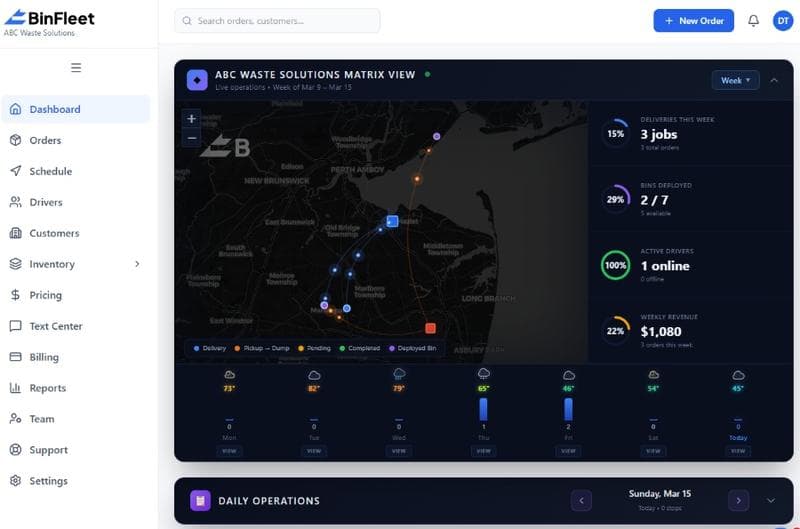
Working with an insurance broker who specializes in waste and recycling is worth the effort. These brokers have relationships with carriers that understand your industry, and they can negotiate better rates because they bring volume. A good broker will also review your operations annually and identify coverage gaps or redundancies. Some carriers offer usage-based or telematics discounts for fleets under a certain size, and others reward electronic driver logs and GPS tracking—tools that BinFleet's dispatch and tracking features provide natively.
Combining multiple policies with a single carrier usually results in a 15–25% discount across your premium. Group your general liability, auto, workers' comp, and pollution coverage under one insurer if possible. Finally, consider raising your deductibles if you have cash reserves to absorb smaller losses. Increasing a $1,000 deductible to $5,000 can reduce your annual premium by 10–20%, which makes sense for financially stable operations that can manage the cash flow impact of a claim.
Common Coverage Gaps and What They Cost
Many haulers overlook coverage for independent contractors or owner-operators who haul under their license. If you work with subcontractors, you need contractual liability insurance or explicit coverage endorsements naming them as additional insureds. Without this, your insurer could deny a claim if a subcontractor is involved, leaving you exposed. This is a common and costly gap that costs very little to fix—usually $300–800 annually in added coverage.
Another gap is inadequate limits. If you primarily serve residential customers, $1 million/$2 million in CGL may be sufficient. But if you land a commercial contract with a large construction company or municipality, they'll often require $2 million/$4 million or higher. Rather than rushing to update coverage when you win a big contract, it's smarter to build adequate limits into your base policy now. The premium difference is usually 15–20%, and it positions you to bid on larger jobs without delay.
FAQ: Dumpster Rental Insurance Questions
Do I need insurance if I'm a solo operator with one truck?
Yes, absolutely. Even with a single truck, one liability claim can exceed your annual revenue. Commercial General Liability and Commercial Auto Liability are non-negotiable. Most customers, especially commercial ones, will require proof of insurance before they book a service. Operating without insurance also violates the terms of your business loan or equipment lease in most cases.
How much does insurance actually cost for a small dumpster rental business?
For a small operation with 2–3 trucks and $500,000–$1 million in annual revenue, expect to pay $3,000–$7,000 annually for a comprehensive package (General Liability, Auto, Pollution, and Workers' Comp). Costs vary by state, claims history, and employee count. Bundling policies and maintaining a clean safety record can reduce this by 20–30%, so proper operational management directly impacts your bottom line.
Can I get a discount if I use dispatch software like BinFleet?
Some insurers offer modest discounts (5–10%) for using GPS tracking and electronic logs, since these reduce accident risk and provide evidence of maintenance compliance. While dispatch software doesn't directly lower premiums, it generates the operational data—maintenance records, driver logs, incident reports—that insurers use to justify preferred rates. Check our blog for more on how operations management impacts insurance costs.
What happens if a customer puts hazardous waste in my dumpster?
Without pollution liability insurance, you bear the cleanup and regulatory costs—often $50,000+. With the right coverage, your insurer handles the claim. This is why pollution liability is essential. You should also implement customer education (signage, contracts) that prohibits hazardous materials, but insurance is your financial backstop when prevention fails.
Take Action on Your Insurance Today
Insurance costs money, but the alternative—operating without coverage—is far more expensive. The best time to review your policies is now, before you face a claim or try to scale your business. Work with a broker who understands waste hauling, audit your current coverage for gaps, and invest in operational systems that generate the safety data insurers reward with lower rates. If you're looking to professionalize your operations and document the safety practices that reduce insurance costs, request a demo of BinFleet to see how integrated dispatch and maintenance tracking can support your insurance optimization strategy.
Ready to Streamline Your Operation?
See how BinFleet AI helps waste haulers save time, cut costs, and grow.
Request a Free 30-Day Trial