How to Scale Your Dumpster Rental Business From One Truck to Multi-Yard Operations
Start With Clear Unit Economics Before You Scale
Many dumpster rental owners jump into growth without understanding what actually makes money. Before you add a second truck, you need to know your true per-haul profit margin, container utilization rate, and average customer lifetime value. Pull six months of data on fuel, maintenance, labor, and hauling time per trip. This baseline becomes your scaling blueprint—if a 20-yard container haul nets $180 profit today, that same metric should guide pricing and dispatch decisions at scale.
The mistake most operators make is underpricing to win contracts during growth mode, then discovering they can't afford the infrastructure to support volume. Lock in your pricing strategy now based on real numbers, not competitor guessing. Once you understand unit economics, you can calculate exactly how many trucks you need to reach your revenue target and whether that target is actually profitable at your current operational efficiency.
Master Single-Location Operations Before Opening New Yards
The difference between a chaotic multi-yard operation and a scalable one is ruthless operational discipline at your first location. Before you open a second yard, every process—from order intake to invoicing—should run without your direct involvement. That means documented procedures, trained staff who follow them, and a dispatch system that works the same way every single day. If you're still manually scheduling routes on a spreadsheet or taking payment over the phone, scaling will multiply your headaches by ten.
Spend the next six months drilling down on two metrics: order-to-delivery turnaround time and customer complaint rate. Get turnaround down to 24 hours or less, and complaints below 2 percent. These aren't arbitrary targets—they're signals that your operations can absorb growth without breaking. Once you've hit those benchmarks consistently, you're ready to replicate the system at a new location.
Build a Technology Foundation That Grows With You
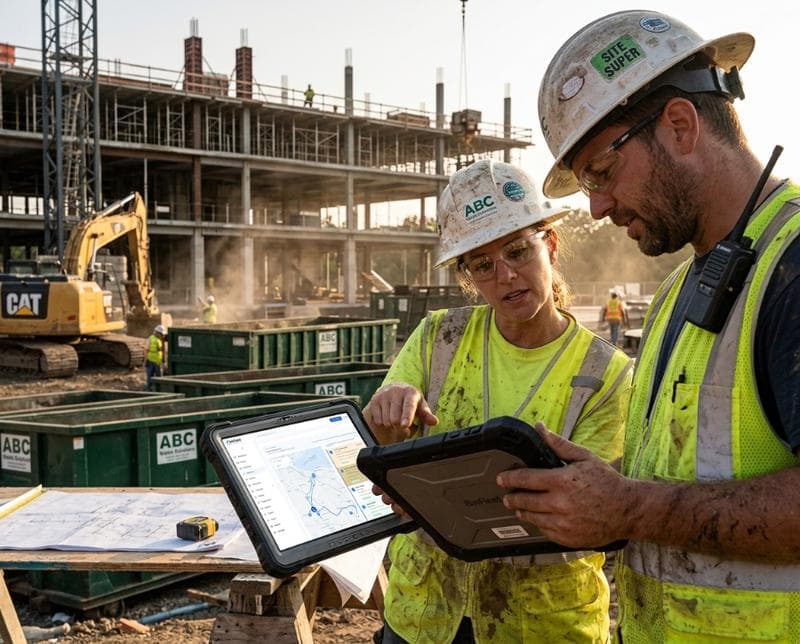
Manual operations feel cheap until you're managing 30 containers and 4 drivers across 2 yards. A dispatch software like BinFleet becomes essential infrastructure at that point, not a nice-to-have. The right platform lets you track container location in real-time, optimize routes so drivers aren't wasting fuel, and send customers automatic SMS updates—cutting down on calls to your office. More importantly, it creates visibility. You'll know exactly which routes are profitable, which customers are churning, and where your delays are happening.
When evaluating software, look for systems that handle multi-yard operations natively, offer real-time GPS tracking, integrate payment processing, and provide reporting on profitability by route and customer. The cost of the wrong software choice—or trying to bootstrap everything with spreadsheets—is far higher than the monthly subscription. Start a free demo with platforms that handle your current volume today but can scale to 10 trucks tomorrow without requiring a complete rebuild.
Hire Smart: Drivers and Dispatchers First
Growth stalls when you run out of reliable drivers. Before you buy the second truck, recruit and train two solid operators—people who show up on time, take care of equipment, and communicate when problems arise. A single bad driver creates ripple effects: missed pickups, customer complaints, and burnout for the rest of your team. Offering $1 to $2 per hour above local market rate for reliability is cheaper than the revenue loss from a no-show or a damaged container.
Your next hire should be a dispatcher or operations coordinator—someone who manages scheduling, communicates with customers, and handles documentation. This person is the nerve center of your growing operation. They free you from day-to-day firefighting and give drivers clear direction. Many scaling owners make the mistake of keeping dispatch duties for themselves while also managing sales and finance. That's a ceiling on growth. Hire a dispatcher when you reach about 15 active containers, before you're drowning in calls.
Inventory and Equipment: Scale Containers Before You Scale Trucks
Adding a second truck without enough containers to keep it busy is a capital-allocation mistake. Before you purchase your next vehicle, invest in 30 to 40 percent more container inventory at your existing yard. This buffer means your first truck always has clean, available containers ready for dispatch, and it tests your storage space and inventory management systems. You'll quickly discover if your current yard can hold 80 containers or if you need to negotiate more space or find a new location.
Use this inventory phase to stress-test your container tracking. Can you quickly locate a 15-yard bin that's been sitting for two weeks? Do you know which containers need repair before they go out? If your current system is a notebook or a mental map, now is the time to fix that. Once you add a second yard, you absolutely need software that tells you the location and status of every container across all locations. Read our guide on container inventory management to understand what tracking should look like at scale.
Financial Planning: The Hidden Costs of Adding Locations
A second truck costs more than just the vehicle payment. Factor in a second driver's salary ($35,000 to $45,000 annually), increased insurance, additional fuel and maintenance, yard space rental or purchase, a second set of containers (usually $3,000 to $8,000 each), and administration overhead. Many owners are shocked to discover that their second truck needs to generate 30 to 40 percent more revenue than their first just to break even on incremental costs. Build a detailed pro forma that projects 18 months of P&L for the expansion, including worst-case scenarios where growth is slower than expected.
Don't rely on your accountant alone for this—they'll give you tax advice, not operational strategy. Map out exactly how many additional customers you need, at what average revenue per customer, to justify the truck purchase. Then overlay your market and sales capacity: can you realistically reach that customer goal in 12 months? If not, you're overextending. Conservative scaling beats aggressive expansion that drains your cash reserves every time.
FAQ
How many containers should I own vs. rent from a supplier?
Most growing operations own 60 to 70 percent of their container fleet and rent the remaining 30 to 40 percent to cover seasonal spikes. Ownership gives you margin and control, but rentals provide flexibility without capital outlay. Calculate your utilization rate: if you're using 85 percent of inventory consistently, ownership makes sense. If you're regularly leaving containers idle, renting is smarter.
When should I hire a second dispatcher?
You need additional dispatch capacity when your single dispatcher is working more than 8 hours daily or missing calls during peak hours. This typically happens around 25 to 30 active containers. A second dispatcher costs $30,000 to $40,000 annually but prevents customer service failures and gives your primary dispatcher time to handle complex scheduling and problem-solving.
What's the minimum revenue I need before opening a second yard?
Your first yard should be generating consistent $3,000 to $4,000 per week in gross revenue with documented profitability before you expand locations. Below that threshold, a second yard spreads your existing revenue too thin and adds overhead. At $4,000 per week, you have the cash flow to absorb the first 6 months of the new location while it ramps.
How do I keep quality consistent across multiple yards?
Standardized processes and regular audits are essential. Document every procedure—how containers are cleaned, how routes are assigned, how customers are followed up with—then audit each yard monthly against those standards. Your software should give all locations visibility into company-wide metrics so you can spot performance gaps early. Monthly manager meetings to review performance and share best practices also prevent yard silos.
Ready to Streamline Your Operation?
See how BinFleet AI helps waste haulers save time, cut costs, and grow.
Request a Free 30-Day TrialRelated Articles
How a Dumpster Rental CRM Transforms Customer Retention & Revenue Growth
How a Dumpster Rental CRM Transforms Customer Relationships Into Revenue Growth