How to Scale Your Dumpster Rental Business from One Truck to Multiple Trucks
Know Your Current Margins Before You Add Trucks
Before scaling, you need honest numbers on what one truck actually generates. Too many operators guess at profitability, then wonder why adding a second truck tanks their margins. Pull your last 12 months of revenue, fuel costs, maintenance, driver wages, and container depreciation. If you're not tracking this data now, start immediately—you can't manage what you don't measure.
Once you have baseline margins, calculate your per-haul profit and daily utilization rate. A truck that runs 8 pulls a day at $120 per pull with 45% margins is very different from one doing 5 pulls at $95 with 35% margins. Understanding this difference tells you whether to optimize your current operation before scaling, or whether your model is already healthy enough to duplicate. Many owners discover they need to raise prices or cut costs on their existing truck first, which actually improves their ability to scale sustainably.
Build Dispatch and Route Systems That Work Without You
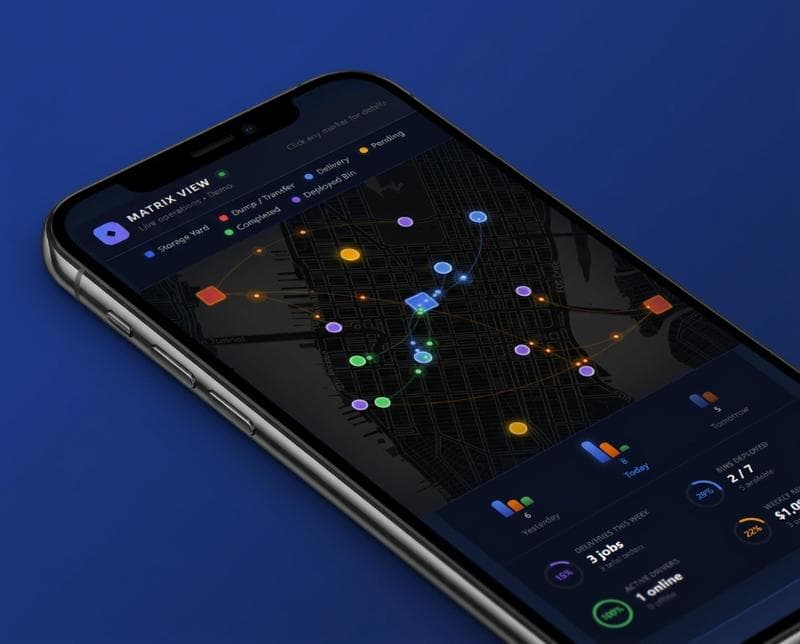
The first truck works because you know every customer, route, and driver issue personally. Truck number two fails because you can't be in two places simultaneously. This is where modern dispatch software becomes non-negotiable. You need a system that assigns jobs to drivers, optimizes routes, tracks container inventory across locations, and sends automated customer updates. Without this, you'll hire a dispatcher just to manage chaos—and a good dispatcher costs money you haven't budgeted.
Look for tools that integrate order management, real-time GPS tracking, and customer communication in one platform. When a customer calls with a question, your dispatcher should answer in seconds. When a driver needs to know their next route, it should be on their phone. When you need tonight's pickup list, it should populate automatically. Seeing how modern platforms work often reveals gaps in your current operation you didn't realize cost you hundreds each week.
Hire and Train Drivers Who Won't Destroy Your Brand
Bad drivers kill scaling plans faster than anything else. A driver who damages a customer's property, leaves a mess, or treats customers poorly can undo months of reputation building. Before you hire driver number two, document your standards: how containers get placed, how to communicate with customers, how to handle complaints, how to spot unsafe conditions. New drivers should spend their first week shadowing your best driver, not reading a handbook.
Pay matters, but culture matters more. Drivers who feel respected and see a path forward stay longer and perform better. This doesn't mean overpaying—it means reliable scheduling, fair treatment, and feedback. When you're scaling, retain your good people first. The cost of replacing an experienced driver is 50-80% of their annual salary in lost productivity and training time. Offering a $1,000 annual bonus to keep your best driver is cheaper than hiring and training a replacement.
Price for Growth, Not Just Today's Volume
Many operators underprice to fill their first truck, then lock in those rates for years. When you scale, that pricing no longer works. Your costs have increased—more drivers to manage, higher insurance, additional containers to depreciate. Some customers will balk at price increases, but you'll lose more profit by staying cheap than by losing a few accounts. Start reviewing your pricing strategy now, before truck two arrives.
Consider your market: do customers respond to service quality, or are they purely price-driven? If quality matters, raise rates 5-8% annually and invest in reliability. If the market is price-sensitive, focus on efficiency—reduce fuel costs through smarter routing, cut container maintenance through better tracking, and minimize downtime. The scaling operation that thrives isn't the cheapest; it's the one that delivers consistent quality at rates that support reinvestment.
Plan Your Yard Space and Container Inventory
One truck needs one yard location and perhaps 20-30 containers to keep busy. Two trucks need a larger yard or a second location, more containers in circulation, and better inventory tracking. Before adding truck two, audit your yard: do you have space to store additional containers? Can you wash and maintain more units without bottlenecking? Do you know where every container is right now, or are some "lost" in customer yards?
Many operators scale and discover they don't actually own enough containers to keep both trucks working. You end up buying more inventory than planned, or drivers wait for empties instead of picking up fills. Use operational planning resources to model container flow before committing capital. A simple rule: aim for 1.5 containers per active truck. One truck with 30 containers is a starting point; two trucks need 60 total to stay ahead of demand and account for maintenance downtime.
Establish Multi-Location Management Systems
Once you're managing multiple trucks across different areas, complexity multiplies. You need systems to track fuel consumption per truck, maintenance schedules, per-driver performance metrics, and per-location profitability. Without these, you can't see which truck is profitable and which is a problem, or whether adding a second yard location actually makes sense. This is where many operators hit their scaling ceiling—not from lack of demand, but from inability to manage what they own.
Implement a simple but consistent operational checklist: daily vehicle inspections, weekly maintenance reviews, monthly financial reports by truck, quarterly customer satisfaction surveys, and annual strategic planning. As you grow to three, four, or five trucks, these systems become the backbone of your business. They tell you which decisions to make next—whether to add a driver, replace a truck, open a new yard, or exit an unprofitable service area.
FAQ: Scaling Questions Haulers Ask Most
When is the right time to add truck number two?
Add truck two when your first truck is consistently running 90%+ utilization (booked most weekdays) and you're turning away work regularly. If you're at 70% utilization, adding a truck spreads your fixed costs too thin and kills margins. Some operators scale too early because they get impatient; others stay single-truck too long and miss revenue. The metric that matters: can you fill both trucks with paying work within 90 days of starting truck two?
Should I hire a dedicated dispatcher before adding truck two?
Not always. A solid dispatch software can handle two trucks with the owner managing it part-time, or a part-time office person. Hire a full-time dispatcher when you hit three trucks or when daily chaos (customer complaints, driver confusion, missed pickups) starts eating your time. Before hiring, test dispatch platforms that automate routing and customer communication—many operators discover they don't need a person if their software does the work.
How much capital should I budget to scale to two trucks?
Budget for the truck (used or new), containers (30-40 units), insurance increase, working capital for fuel and labor, and potential yard upgrades. This ranges from $80,000 to $200,000 depending on whether you buy used or new equipment and your local market rates. Don't stretch yourself thin—undercapitalized scaling operations fail because they can't handle seasonal dips or equipment breakdowns. Conservative funding, steady growth, and reinvested profits typically outperform aggressive borrowing.
What's the most common mistake when scaling to multiple trucks?
Underestimating management complexity. An owner who can run one truck profitably often struggles managing two because the skills required are different. Single-truck operators need to be hustlers; multi-truck operators need to be systems builders. Many scaling attempts fail because the operator hasn't transitioned from doing the work to managing the work. Success means documenting processes, hiring reliable people, and trusting systems—not being everywhere at once.
Your Scaling Timeline for 2026
If you're running one truck today and want to scale by 2026, the path is clear. Spend Q1 building financial transparency and operational systems. Q2-Q3, optimize your current truck's utilization and margins. Q4, strengthen your team and upgrade your dispatch capabilities. By Q1 2026, you're ready to add truck two with confidence. Q2-Q4 2026, you're running two trucks efficiently and planning truck three.
Scaling isn't about moving fast—it's about moving smart. The operators who grow sustainably are the ones who understand their numbers, invest in systems before adding capacity, and build teams that work without them. Start now, and by the end of 2026, you could be running a multi-truck operation that actually pays you for running it, instead of consuming all your time.
Ready to Streamline Your Operation?
See how BinFleet AI helps waste haulers save time, cut costs, and grow.
Request a Free 30-Day TrialRelated Articles
How a Dumpster Rental CRM Transforms Customer Retention & Revenue Growth
How a Dumpster Rental CRM Transforms Customer Relationships Into Revenue Growth