How to Scale Your Dumpster Rental Business: A Step-by-Step Growth Plan
Understand Your Current Bottleneck Before Scaling
Most dumpster rental owners think the path to scaling is simple: buy more trucks, hire more drivers, repeat. In reality, your bottleneck is rarely equipment. It's almost always operations. If you're running dispatch via phone calls and spreadsheets, adding a second truck won't double your revenue—it'll triple your headaches. Before you invest in new assets, you need to identify whether your constraint is customer demand, driver availability, container inventory, or the systems that coordinate all three.
The smartest first step is an honest audit of your current operation. How many jobs can you physically handle with your current truck? Are you turning away work because you lack vehicles, or because you can't manage the orders coming in? Are your drivers spending 30 minutes per pickup because they're manually logging information, or because your service area is genuinely saturated? Understanding this distinction determines your scaling strategy. BinFleet helps operators see these bottlenecks clearly by consolidating orders, inventory, and driver data in one platform, making it obvious where growth is actually possible.
Build Systems Before You Build the Fleet
Scaling fails when owners treat their dispatch, billing, and customer communication as afterthoughts. By the time you have three trucks, manual processes become liabilities. A single dispatcher trying to manage orders, track multiple vehicles, and answer customer calls will miss pickups, double-book containers, and create safety risks. The best time to implement a proper system is before you need it, not after your operation falls apart from growth.
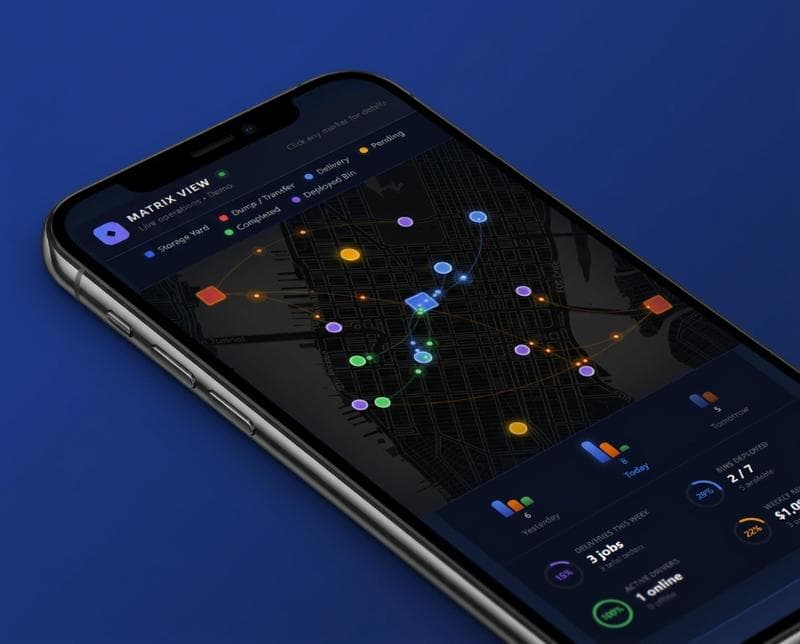
Invest in a software platform that handles orders, real-time dispatch, customer notifications, and basic inventory management. Your second truck should arrive into a world where every order is logged, every driver location is tracked, and every customer gets an automated SMS update when their bin is picked up. This removes the chaos that kills growth and lets you focus on sales and customer relationships instead of firefighting operational gaps. A live demo of dispatch and routing tools shows exactly how this prevents the common scaling failures we see in the industry.
Hire for Growth, Not Just Replacement
Adding a second driver means more than splitting shifts. You're adding complexity to scheduling, training, fuel costs, and insurance. Most owners wait until they're completely desperate to hire, which means bringing on drivers quickly without proper onboarding. This creates inconsistent customer service, higher accident rates, and poor retention. A better approach is to hire incrementally—bring on your second driver when you're at 75% capacity with your first truck, not at 95%. This gives you breathing room to train properly and prove the economics work before scaling further.
Your hiring plan should tie directly to customer demand forecasts. If you're growing at 20% year-over-year, you need to be recruiting drivers 3-4 months ahead of when you'll actually need them. Pay competitive wages for your market (not minimum wage), provide clear vehicle safety protocols, and make sure they understand your customer service standards. Cheap drivers cost exponentially more in insurance claims, repeat customer complaints, and turnover. The driver shortage in 2025-2026 means quality operators will have their pick of jobs—you need to offer real incentives.
Manage Container Inventory Like It's Your Cash Flow
Scaling the fleet is useless without scaling your container inventory. Too many owners buy trucks before they buy enough bins. You need at least 1.5 to 2 bins per truck in rotation, depending on your service area and pickup frequency. If you have three trucks but only six bins total, you'll constantly be waiting for pickups to complete before you can accept new jobs. Your trucks become idle assets, and your driver is sitting in traffic instead of working. Container inventory directly determines how many orders you can accept simultaneously.
As you scale, implement a simple bin tracking system—either with GPS tags, manual audit sheets, or integrated software—so you know where every container is at any moment. Scaling to five trucks without visibility on your bin locations will result in customers waiting days for pickup, lost revenue from bins sitting on customer sites, and confusion about what you actually own. This is where a platform with integrated inventory management prevents costly mistakes and keeps your return-on-investment timeline realistic.
Price Growth Correctly and Protect Your Margins
The biggest mistake scaling operators make is offering discounts to grab volume. Adding four more trucks doesn't help if your margins are shrinking. Your pricing should reflect your actual operating costs: fuel, maintenance, insurance, driver wages, and overhead allocation per truck. Many single-truck owners quote prices based on gut feeling. As you scale, you need real unit economics. Calculate your cost-per-pickup by truck, your average revenue-per-order, and your target margin (typically 35-50% for dumpster rental companies). Anything below that shouldn't be a job you take.
Growth also gives you leverage to raise prices slightly. If you're at 85% capacity and getting more calls than you can handle, that's the time to increase your minimums or service fees. Scaling doesn't mean racing to the bottom of pricing—it means becoming selective about which jobs you take and building a reputation for reliability that justifies premium pricing. Customers would rather pay 10-15% more for a hauler who shows up on time and treats their property with respect than save money with someone who cuts corners.
Build a Second Location Only When the First Is Proven
Multi-yard operations are the next frontier after you've stabilized a single location with 5-10 trucks. Don't open a second yard until your first yard is running profitably with minimal owner involvement. The moment you're managing two locations, your complexity quadruples: separate driver schedules, equipment maintenance at two sites, inventory spread thin, and your own attention divided. Most operators attempt this too early and end up with two struggling locations instead of one strong one.
The right time to expand geographically is when a single dispatcher can no longer manage the order volume at your current location, and you're getting customer requests from areas outside your service radius. At that point, a second yard makes sense. But it should have its own management structure, its own driver team, and its own equipment. You're not splitting your first operation—you're creating a second, identical one and eventually stacking them under a shared back-office. This requires systems that scale across multiple locations, which is why operational best practices in our blog address multi-yard complexity in detail.
FAQ: Common Questions About Scaling a Dumpster Rental Business
How much does it cost to add a second truck to my operation?
A used roll-off truck costs $40,000-$70,000, depending on age and condition. Add insurance ($2,000-$4,000 annually), maintenance reserves, and a driver salary ($50,000-$60,000 per year), and you're looking at roughly $70,000-$90,000 in first-year costs to add capacity. The break-even depends entirely on how much work you can generate to fill that truck. If you can average 8-10 jobs per day at $150-$250 per job, you'll reach profitability within 12-18 months. Without that demand pipeline, you've just bought an expensive liability.
Should I hire my own drivers or use a contractor model?
W-2 employees give you operational control, consistent service, and easier scaling. Contractors are cheaper upfront but create liability risk and inconsistency as you grow. Most successful scaling operations switch to W-2 drivers by their third or fourth truck. Contractors work when you need overflow capacity, but they shouldn't be your core operation. Customers call back because they want the same driver and the same quality—that only happens with employees who have real skin in your business.
When should I implement software like BinFleet instead of using spreadsheets?
The honest answer: as soon as you're consistently turning away work because your current systems can't handle it. If you have two trucks and you're still comfortable with phone dispatch and manual invoicing, you can wait. But the moment your dispatcher is juggling more than 15-20 active orders per day, you need software to prevent mistakes. For most operators, that threshold hits around truck number two or three. Seeing a live platform demo shows how much time and errors a proper system actually prevents, and the ROI is obvious when your dispatcher can manage 40+ orders instead of 20.
What's the realistic growth timeline from one truck to five trucks?
In a mature market with solid demand, you can realistically add one truck per year if you're hiring strategically and not over-extending financially. Five trucks represents roughly 3-4 years of disciplined growth. If you try to force faster expansion, you'll run out of cash, create service quality problems, or both. The owners who scale sustainably focus on profitability at each stage, not vanity metrics like truck count. A single truck running at 60% margin beats five trucks bleeding money at 15% margin every single time.
Ready to Streamline Your Operation?
See how BinFleet AI helps waste haulers save time, cut costs, and grow.
Request a Free 30-Day Trial