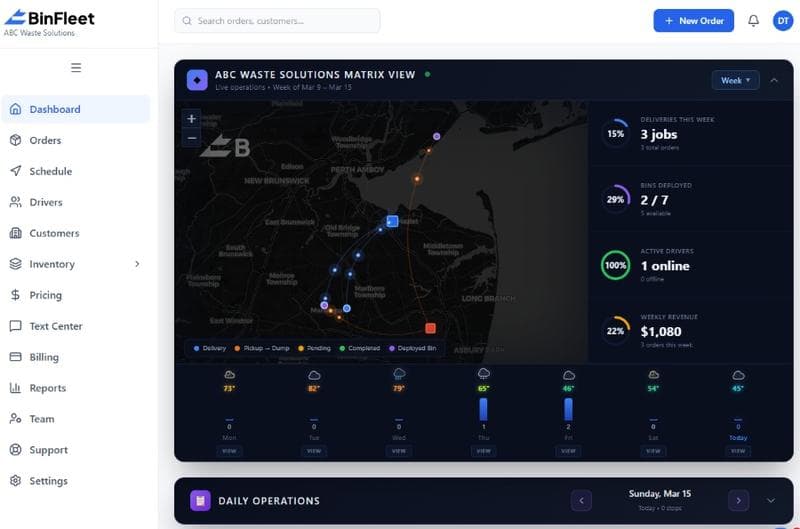
How Driver Apps Transform Waste Hauling Operations
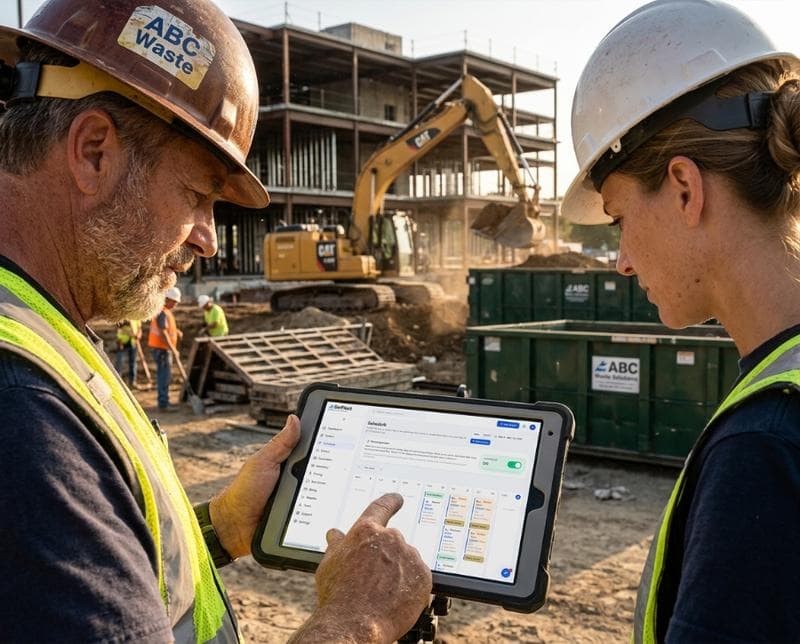
The Problem: Blind Spots in Your Fleet Operations
Every day without mobile visibility costs your waste hauling company money. Drivers hand-write route notes, customers call in wondering where their dumpster is, and you're left guessing whether a pickup actually happened or when it'll finish. Your dispatcher is playing detective instead of optimizing routes, and proof of service? It's either a blurry photo from someone's personal phone or scattered paperwork that takes hours to file.
The bigger issue is that fragmented operations slow everything down. When drivers can't confirm a stop was completed in real-time, invoicing gets delayed. When you don't have photo evidence tied to each pickup, disputed charges become a nightmare. And when customers have no visibility into when their bin will arrive, they call—a lot. A proper driver app eliminates these friction points and gives you a single source of truth for what happened on every route.
Real-Time Stop Management and Route Transparency
A mobile driver app turns vague route schedules into concrete, timestamped actions. As your driver arrives at each stop, the app records the GPS location, time stamp, and allows them to mark the job complete without ever touching paper. Dispatchers see this happen in real time, so they can catch delays early, reassign jobs if needed, and answer customer questions with actual data instead of guesses. This transparency eliminates the back-and-forth communication that drains your team's time and frustrates customers.
Route efficiency improves because dispatchers can see exactly where vehicles are and how long each stop takes. Over time, that data becomes invaluable for optimizing future routes, improving time estimates, and spotting patterns—like which residential routes take longer during certain seasons. When drivers have a clear, updated stop list on their phone and can confirm completion instantly, they also make fewer mistakes. No forgotten pickups, no duplicate drops, no "I thought we already got that one" confusion.
Photo Capture and Compliance Documentation
Photographs are your proof of service, and they matter. A driver app built for waste hauling lets drivers snap photos directly from the job details screen, automatically linking them to the stop, time, and location. No more digging through phone galleries or dealing with unlabeled images. This is especially critical for large commercial accounts where disputes over billing or service can spiral into contract arguments. One clear photo showing the container was removed, cleaned, or replaced closes those conversations fast.
Beyond disputes, photos build accountability and quality control. If a driver takes a photo showing an overfilled bin or damaged container, your office sees it immediately and can reach out to the customer before bigger issues occur. Some waste haulers use photo capture to verify dumpster condition at the start and end of a rental, creating an undeniable record. In 2026, when customer expectations around transparency keep rising, having timestamped, location-verified photos baked into your operations isn't a nice-to-have—it's a standard cost of doing business professionally.
Automated Customer Notifications and Status Updates
Customers want to know their service is on the way. A driver app integrates with your dispatch system to automatically send SMS or in-app notifications when a driver is approaching a stop, when the job is complete, and sometimes when the driver has left the site. These updates dramatically reduce customer service calls and improve satisfaction scores. The customer doesn't have to guess anymore; they receive a message saying "Your bin pickup is scheduled for today between 2–4 PM" and then "Your pickup was completed at 2:47 PM"—all triggered by actual driver actions in the app.
This automation also frees your office staff from manual phone updates and status emails. Instead of a customer calling in and asking where their driver is, the customer gets a proactive notification. This shift from reactive support to proactive communication changes your customer experience perception. It's a small detail that costs almost nothing to implement but registers as professionalism to the customer, and that translates into longer contract renewals and referrals.
Integration with Dispatch, Invoicing, and Analytics
A standalone driver app is helpful; an integrated one is transformative. When your driver app connects seamlessly to your dispatch system, every stop completion flows directly into your invoicing system with zero manual data entry. No more re-typing addresses or copying route information. The driver confirms the job, the system records the timestamp and photos, and your billing engine has everything it needs to generate accurate invoices same-day. That reduces your accounts receivable cycle and catches billing errors before they become customer disputes.
The analytics layer is where smart haulers gain competitive advantage. You can analyze driver performance, identify which routes are profitable and which are bleeding money, track average stop duration, and forecast capacity needs. Over months, this data reveals patterns—like seasonal fluctuations or specific customer types that require more time—that let you make informed decisions about pricing, routing, and staffing. A driver app isn't just a tool for today; it's the foundation for data-driven growth decisions tomorrow.
Choosing the Right Driver App for Your Operation
Not all driver apps are built the same. Some are generic field service tools that require workarounds for waste hauling. Others are purpose-built for the industry and understand your specific needs: bulky items, weight restrictions, special handling for hazardous waste, and multi-yard operations. When evaluating a driver app, look for offline functionality—your drivers often work in areas with spotty cellular coverage—and make sure it handles photo capture, signature capture if needed, and integrates with your existing dispatch and accounting software.
User adoption is critical. A powerful app that drivers hate using will sit idle on their phones. The best driver apps are intuitive, require minimal taps to complete a stop, and actually make a driver's day easier, not harder. They should work on older Android and iPhone models, load fast even on slower connections, and sync reliably when the driver regains signal. If you're evaluating a demo of a driver app platform, test it in the field with actual drivers before committing. Their feedback will tell you whether it solves real problems or adds overhead.
FAQ: Driver Apps for Waste Haulers
How much do driver apps typically cost?
Pricing varies widely based on features and scale. Some basic apps charge $5–$10 per driver per month, while comprehensive platforms that include dispatch, invoicing, and analytics might charge $30–$100+ per driver monthly, often with a minimum fleet size requirement. The key is calculating ROI: if an app saves you 15 minutes per driver per day through reduced paperwork and fewer billing disputes, that typically pays for itself within months. Many platforms offer flexible pricing tiers, so you can start small and scale as you grow.
Will our older drivers adopt a mobile app?
Age isn't the barrier—usability is. An app built specifically for waste hauling with large buttons, simple workflows, and minimal scrolling will be adopted by most drivers regardless of age. Older drivers often appreciate tools that reduce paperwork, so frame it as making their job easier, not forcing technology on them. Provide 15 minutes of hands-on training and have a support contact for questions, and adoption rates tend to be strong across age groups.
What happens if a driver loses cell service?
Robust driver apps work offline, storing stop data locally and syncing when service returns. This is non-negotiable for waste hauling since you often work in rural areas or tunnels where coverage drops. Before selecting an app, test offline functionality with your actual routes. The app should let drivers mark jobs complete, take photos, and record signatures offline, then automatically sync when back in range—with no data loss.
Can a driver app integrate with our current dispatch and accounting software?
It depends on the app and your existing systems. Modern platforms like BinFleet are built to integrate with common dispatch and accounting tools, and many offer APIs for custom integrations. Some legacy systems require manual data transfer, which defeats much of the efficiency gain. When evaluating a driver app, ask specifically about integration capabilities with your current stack—and don't accept vague promises. Get a technical spec or proof of concept before you commit.
Moving Forward: Making the Driver App Decision
The waste hauling industry has moved past the era of paper clipboards and phone tag. Drivers in the field, customers expecting real-time updates, and your operational team all benefit when you deploy the right mobile app. The best driver apps don't just digitize paperwork—they eliminate unnecessary steps, build accountability, and create data that helps you run a smarter, more profitable business.
If you're ready to see how a purpose-built driver app can streamline your operations, the next step is testing one in the real world. Request a demo to walk through how driver mobile apps work alongside dispatch and invoicing, or explore more insights on optimizing waste hauling operations in our blog. The goal isn't technology for its own sake—it's operations that run smoother, drivers who spend less time on admin, and customers who feel informed every step of the way.
Ready to Streamline Your Operation?
See how BinFleet AI helps waste haulers save time, cut costs, and grow.
Request a Free 30-Day TrialRelated Articles
How a Mobile Driver App Transforms Waste Hauling Operations
Driver Apps for Waste Haulers: How Mobile Technology Transforms Daily Operations