How a Dumpster Rental CRM Transforms Customer Relationships Into Recurring Revenue
Why Dumpster Rental Companies Need a CRM (And Why Spreadsheets Fail)
Most dumpster rental operators still manage customer data in spreadsheets, email folders, or loose notes scribbled on dispatch tickets. This fragmented approach works until your business grows past 50 active accounts. Then suddenly, renewal dates get missed, follow-up calls never happen, and you lose customers to competitors who stay in touch better. A CRM built for waste hauling solves this by centralizing every customer interaction—service calls, contract terms, payment history, and growth opportunities—in one searchable system that your whole team can access.
The real cost of poor customer management isn't just lost revenue; it's the operational chaos that follows. Your dispatcher doesn't know that a customer's contract expires next month. Your sales person doesn't see that an account has been ordering 4 bins per week for six months and might need a permanent placement. Your billing team sends a renewal notice, but the customer already switched providers. A CRM eliminates these gaps by making customer intelligence visible to everyone who needs it, turning your team from reactive order-takers into proactive account managers.
Better Customer Retention Through Visibility and Timing
Customer churn in waste hauling typically happens in silence. Accounts quietly expire or get poached by competitors, and you don't realize what happened until they've already left. A CRM with contract tracking and renewal reminders ensures that someone on your team reaches out 30, 60, or 90 days before expiration. This simple act of staying in touch—before the customer even realizes they need to renew—cuts churn dramatically. When a customer hears from you proactively, it reinforces that you value their business and aren't just waiting for the next order.
Beyond renewals, a CRM lets you track the health of each account by monitoring frequency of orders, payment reliability, and service issues. If an account that normally orders weekly suddenly goes quiet for three weeks, that's a red flag your team should investigate immediately. Maybe they're testing a competitor. Maybe they had a bad experience. Either way, knowing about it fast gives you a chance to win them back. The companies with the lowest churn rates in waste hauling aren't the ones with the cheapest pricing—they're the ones that notice problems early and fix them before customers leave.
Identifying Upsell and Cross-Sell Opportunities at Scale
Every customer in your system has growth potential that you're probably missing. A construction company that rents two 30-yard bins per week might also need a dedicated roll-off container or recurring office waste service. A retail strip mall ordering a single 6-yard bin could support three more bins if you approached them with a proper waste audit. But you'll never know these opportunities exist unless you're systematically reviewing account data—something that's nearly impossible with spreadsheets but effortless with a CRM. When your team has a complete view of what each customer orders, when they order it, and what their facility size is, spotting growth plays becomes automatic.
The strongest upsells come from understanding customer patterns that emerge over time. If a customer's order volume spikes during certain seasons, you can proactively offer flexible recurring service instead of waiting for them to request it. If they have multiple locations and you only service one, a CRM makes it obvious to approach them about the others. These conversations don't feel pushy because they're based on real data about their needs, not just cold outreach. In 2026, customers expect vendors to understand their business, and a CRM is the tool that makes that expectation realistic.
Streamlined Communication and Accountability Across Your Team
Without a CRM, customer communication happens across text messages, phone calls, email, and verbal conversations between staff members. Critical details get lost, promises get forgotten, and customers end up having the same conversation twice with different people on your team. This frustrates customers and wastes your time. A CRM creates a central communication log where every interaction—quote, call, text, email, complaint, compliment—gets recorded and is visible to anyone on your team who needs context. This means your dispatcher knows exactly what promises were made, and your billing person can explain why a recent service call appears on the invoice.
Accountability also improves because follow-ups aren't optional—they're tracked and assigned. If a sales rep promises to call a prospect on Thursday, a CRM reminder ensures that call happens or it surfaces as overdue. If a service issue is logged, you can set an automatic follow-up task so the customer gets checked on within 48 hours. This structure doesn't feel like micromanagement when everyone on your team sees the same system working for them. It reduces the chaos of "did someone follow up on that complaint?" and replaces it with clear visibility into what's been done and what still needs attention.
Data-Driven Decisions About Where to Invest
A CRM designed for waste hauling gives you real metrics about profitability, lifetime value, and acquisition cost for each customer. You might discover that 20% of your accounts generate 80% of your revenue—or that some accounts are barely profitable after accounting for service calls and write-offs. This intelligence lets you make strategic decisions: Do you invest more in accounts with the highest lifetime value? Do you phase out problem customers? Do you adjust pricing for accounts that demand excessive service? Without data, these decisions are guesses. With a CRM, they're backed by facts.
Revenue attribution also becomes clear. You'll know which customers came from referrals, which from your website, which from a sales rep's effort, and which are inherited from previous operators. Over time, this tells you where to invest your marketing budget and which sales tactics actually work. By 2026, the waste haulers winning on growth are the ones operating on data, not intuition. A CRM is the foundation of that data-driven mentality, and it compounds as your system gets richer with customer history.
Integrating CRM With Your Operational Stack
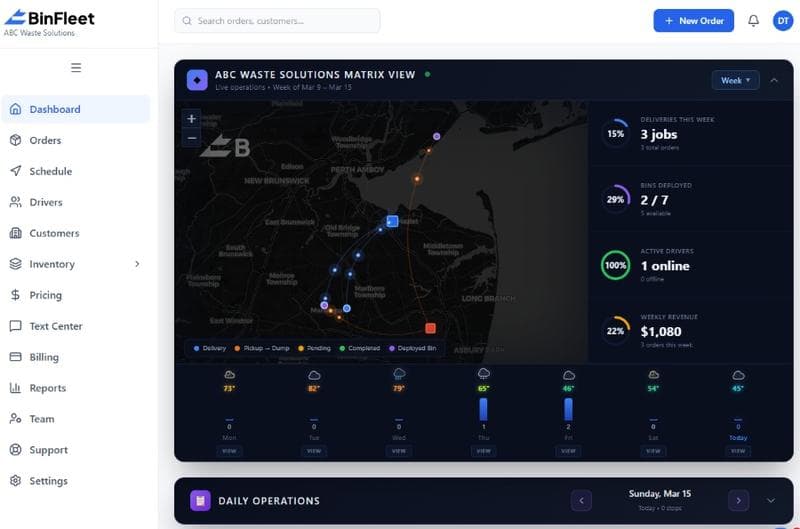
A CRM that only sits in isolation is useful but limited. The real power comes when it's connected to the rest of your business—your dispatch system, your invoicing, your container tracking. When a customer places an order through your online portal, that data should automatically flow into your CRM so your account manager sees the activity. When an invoice is sent, the customer's payment history should be right there for context. When a driver notes a service issue in the field, it should create a follow-up task in the CRM. Platforms like BinFleet integrate CRM functionality with dispatch, inventory, and billing so data flows in one direction, eliminating the double-entry and miscommunication that kills efficiency in fragmented systems.
This integration also means your team doesn't need to log into five different platforms. Dispatchers stay in the dispatch interface. Your office team works in a unified system that handles orders, billing, and customer relationships together. The fewer places your team has to manually enter or look up data, the faster things move and the fewer errors happen. For waste hauling companies looking to scale from 50 accounts to 500, this consolidation is the difference between adding headcount and running the same volume with the same team size.
FAQ: Dumpster Rental CRM Questions
How long does it take to see ROI from a CRM system?
Most waste hauling companies see measurable improvements in retention and billing accuracy within 60 days. If your current churn rate is 15% and a CRM brings that down to 10%, that improvement alone pays for the software. The full ROI—including increased upsells and operational efficiency—typically shows up within 3–6 months as your team learns the system and customer data builds up.
Do I need a CRM if I have a dispatch system?
A dispatch system manages routes and orders; a CRM manages relationships and revenue growth. You technically need both, though modern platforms like BinFleet combine them so you're not juggling separate tools. A dispatch-only system tells you what was delivered. A CRM tells you why that customer matters, when they might leave, and what they might buy next.
Will our team actually use the CRM, or will it sit unused?
Adoption depends on whether the CRM makes your team's job easier or adds extra work. If it requires manual data entry on top of what they already do, adoption will be low. If it eliminates double-entry and surfaces actionable intelligence they can't get any other way, adoption happens naturally. The best CRMs for waste hauling are designed by people who understand dispatch and billing, not generic enterprise software vendors.
How much customer data do I need to have before a CRM is useful?
A CRM starts delivering value immediately, even with just a handful of accounts. It becomes increasingly powerful as you add more historical data and customer interactions. If you're starting from scratch, the sooner you implement one, the sooner you'll have years of data to leverage for predictive insights and smarter decision-making.
The dumpster rental companies winning in 2026 are the ones that treat customer relationships as a strategic asset, not a back-office chore. A CRM gives you the visibility and tools to retain more customers, grow their accounts, and operate with less chaos. If you're curious how this works in practice, request a demo of BinFleet to see how a modern waste hauling platform brings CRM, dispatch, and billing together. Or explore more on our blog about scaling your operation without adding overhead. Starting a free trial takes 10 minutes, and there's no credit card required.
Ready to Streamline Your Operation?
See how BinFleet AI helps waste haulers save time, cut costs, and grow.
Request a Free 30-Day TrialRelated Articles
How a Dumpster Rental CRM Transforms Customer Relationships Into Recurring Revenue
How a Dumpster Rental CRM Transforms Customer Relationships Into Revenue Growth