How Dumpster Rental Companies Optimize Routes to Cut Fuel Costs and Increase Daily Stops
The Real Cost of Poor Route Planning in Waste Hauling
Most dumpster rental operators still plan routes manually or rely on drivers' experience. This approach leaves money on the table. A poorly sequenced route wastes 10–20% of daily fuel, extends driver hours, and caps the number of stops your team can complete. For a hauler running five trucks, that inefficiency translates to $200,000–$400,000 wasted annually on unnecessary mileage alone. Beyond fuel, poor routing creates driver fatigue, increases vehicle wear, and delays customer service windows, all of which chip away at profitability and reputation.
The challenge compounds when you scale. A single dispatcher managing 15 stops across three trucks will struggle to weave an efficient path through traffic, weather, and customer time windows. Drivers end up backtracking, idling in traffic, and taking longer breaks because the route doesn't make geographic sense. Modern waste haulers can't afford this inefficiency—especially with fuel prices, labor costs, and customer expectations higher than ever. The solution isn't working harder; it's working smarter through deliberate route structure.
Geographic Clustering: The Foundation of Efficient Routes
The first step toward better routes is grouping stops by location. Instead of treating every pickup as an independent task, organize them into zones or clusters that flow naturally through your service area. If your team serves a 30-mile radius, divide it into north, south, east, and west quadrants, then sub-cluster by density. High-density areas (urban neighborhoods or business parks) should have tighter routes with more stops per run. Lower-density areas require longer travel between stops and fewer daily pickups. This geographic logic reduces deadheading—the wasteful practice of driving between stops with an empty truck—and creates natural, logical sequences that drivers can execute without second-guessing.
Assigning stops to clusters should account for time windows and standing contracts. A customer who needs a pickup every Tuesday in Zone A should stay in that zone, not bounce across your service area. When you lock clusters to days and drivers, you build consistency and trust. Drivers learn their territories, anticipate traffic patterns, and develop relationships with repeat customers. This predictability also lets you schedule preventive maintenance and pre-load equipment, rather than rushing to react. Geographic routing also makes it easier to handle exceptions—if a same-day request comes in, you know which driver and truck are closest, and you can integrate the stop without blowing up the entire day.
Using Dispatch Software to Sequence Stops Intelligently
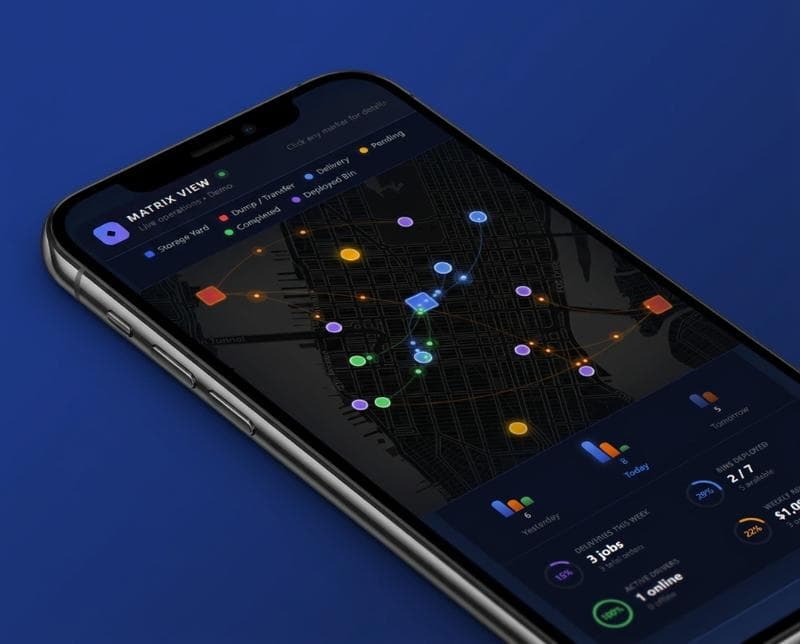
Manual route planning works for five stops. Beyond that, software becomes essential. Dispatch software uses algorithms to sequence stops by distance, time, and vehicle capacity, then dynamically adjusts when new orders arrive or drivers run late. The best tools integrate real-time traffic data so routes account for congestion, construction, and weather—not just straight-line distance. When your dispatcher can see that a detour adds 12 minutes but picks up two stops, they can make that trade-off in seconds instead of guessing. BinFleet's dispatch module lets dispatchers visualize all active routes on a map, see driver locations in real time, and optimize routes before the day starts or on the fly if priorities shift.
The secondary benefit of software is consistency. Algorithms don't have bad days or forget to account for a tight alley. They sequence stops the same way every time, which trains drivers to expect rational route logic and follow it accurately. Drivers spend less time on the phone asking for directions or confirming addresses because the route is clear, documented, and optimized. This reduces dispatcher overhead too—instead of managing small decisions all day, your dispatcher oversees strategy and handles exceptions. Over time, your team's actual performance starts to match theoretical efficiency, and you'll notice daily stop counts rising without adding trucks or hours.
Time Windows and Customer Availability: Balancing Efficiency and Service
Not all stops are created equal. Some customers are flexible; others demand specific time windows. Building routes around hard constraints—like a Monday morning pickup that must happen before 9 a.m. or a Friday afternoon drop-off between 2–4 p.m.—requires careful sequencing. The key is clustering stops with compatible windows so drivers aren't crisscrossing to meet arbitrary deadlines. If three customers all need morning service in the same area, stack them back-to-back. If evening service is scattered across your territory, combine it with a dedicated evening route rather than tacking it onto a day route and creating a bottleneck.
Proactive communication also matters. Offering customers a flexible window (e.g., "anytime Tuesday 10 a.m.–5 p.m." instead of "exactly 2 p.m.") gives dispatchers room to optimize around their preferences. Many waste haulers find that customers are flexible if they're not caught off guard—it's the surprise deviation that creates friction. BinFleet's customer portal lets clients request service windows and track driver arrivals, reducing the back-and-forth and letting dispatchers focus on optimization rather than negotiation. When constraints are baked into the system from the start, routes become more efficient and customer satisfaction actually improves because expectations are clear.
Driver Training and Accountability for Route Adherence
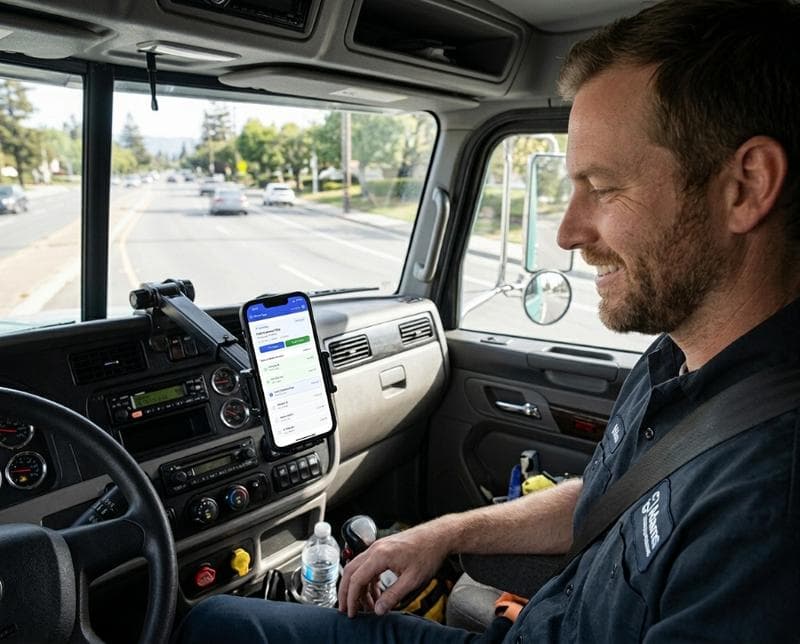
Even a perfectly optimized route fails if drivers don't follow it. GPS-equipped trucks show whether a driver is sticking to the planned sequence or taking shortcuts. The data reveals patterns: some drivers consistently deviate, others follow routes religiously. Rather than punish deviation, use it as a coaching opportunity. A driver who skips a planned stop to service a friend, or who doubles back because they missed a turn, needs a conversation about why the route was designed that way. Maybe the route genuinely has a flaw—a one-way street or a construction zone—that your dispatcher doesn't know about yet. Maybe the driver has a faster route based on local knowledge that should be documented for other drivers.
Building a culture of accountability starts with transparency. Share route optimization metrics with your team: average stops per day, fuel per stop, on-time performance. When drivers see that Route A averages 18 stops per day and Route B averages 14, they understand that small choices add up. Incentivize efficiency—perhaps through a bonus for hitting weekly targets or recognition for maintaining schedule adherence. The goal isn't to squeeze drivers; it's to align incentives so everyone benefits from optimized routes. Efficient routes mean shorter workdays, fewer rush hours, and less stress. Drivers who understand this are more likely to stick to the plan and contribute improvement ideas.
Real-World Impact: Measuring Fuel Savings and Productivity Gains
When you implement route optimization, expect measurable improvements within weeks. Most operators report 8–15% fuel savings, 1–3 additional stops per truck per day, and 10–20% faster route completion times. For a mid-sized hauler running five trucks at 16 stops per day, adding just two stops per day means 50 extra pickups weekly—10% more revenue from the same assets. Fuel savings on top of that are direct profit. Over a year, the cumulative effect is substantial: if you cut fuel costs by 10% ($120,000 on a $1.2M fuel budget) and add 10% volume (another $200,000 in gross revenue), that's $320,000 of additional annual profit from software and process improvements alone.
Start measuring these metrics now. Track fuel per stop, stops per route, on-time rate, and customer complaints related to timing. Baseline your current performance, then implement clustering and dispatch software as a pilot on two routes or one truck. Compare the before-and-after over 4–6 weeks. If you see the expected gains, roll out to your entire fleet. If you don't, dig into why—it might be that your service area is too spread out, your customer mix isn't compatible with clustering, or your drivers need more training. The point is to iterate based on data, not assumption. Our blog has case studies and guides showing how similar operators achieved these results.
FAQ: Route Optimization Questions Waste Haulers Ask
Can route optimization work if I have mostly on-demand pickups?
Yes, but you'll need a dispatch tool that can optimize in real time. On-demand orders will disrupt pre-planned routes, so your software needs to dynamically slot new stops into the best available truck route without manual rework. Clustering your service area and having flexible time windows still applies—you just update routes more frequently. Even with high volatility, you'll see 5–8% fuel savings and better stop density than pure ad-hoc dispatch.
How long does it take to see ROI from dispatch software?
Most haulers see payback within 6–9 months if they're running at least 50 stops daily across three or more trucks. The fuel and labor savings accumulate quickly. For smaller operations (under 30 stops daily), the ROI takes longer, but route optimization still improves service quality and driver satisfaction, which have value beyond pure math.
What if my drivers don't trust the algorithm?
Involve them in the transition. Show drivers why the algorithm chose a particular sequence, let them input local knowledge that improves future routes, and celebrate efficiency wins together. Driver buy-in is the single biggest factor in successful rollout. If your team sees that optimized routes reduce their workload and stress, adoption is natural.
Do I need GPS tracking for route optimization?
GPS tracking isn't strictly required for planning, but it's essential for execution and continuous improvement. Without it, you can't verify that routes are being followed or collect data to refine future sequences. Most dispatch platforms include GPS as standard, and the visibility benefit alone justifies the investment.
Ready to optimize your routes? Route inefficiency is costing you thousands annually. See how BinFleet's dispatch and routing tools help waste haulers add stops and cut fuel costs. Start your free trial today and measure the impact on your first week of routes.
Ready to Streamline Your Operation?
See how BinFleet AI helps waste haulers save time, cut costs, and grow.
Request a Free 30-Day TrialRelated Articles
Dumpster Route Optimization: How to Cut Fuel Costs and Maximize Daily Stops
How Dumpster Dispatch Software Eliminates Manual Scheduling Errors