How Dumpster Dispatch Software Eliminates Manual Scheduling Errors
The Hidden Cost of Spreadsheets and Phone Calls
If you're still managing dumpster pickups through spreadsheets, email chains, and phone calls to drivers, you're bleeding money in ways that don't show up on a single invoice. A dispatcher juggling 30 orders on a Tuesday morning is making route decisions on incomplete information—they don't know that driver three called in sick until 8 AM, or that a customer cancelled but nobody updated the list, or that two pickups are scheduled within minutes of each other across town. Each error compounds: missed pickups lead to angry customers, unscheduled trips waste fuel, and overtime climbs because nobody mapped an efficient route in the first place.
The real problem isn't that your team is lazy or incompetent. It's that the human brain isn't built to optimize 50 variables at once while managing real-time disruptions. A single scheduling mistake can cost you $200 in wasted miles, a $500 customer churn, and damaged reputation that spreads through your service area. When you multiply that across even a 10-truck operation, you're looking at thousands of dollars in preventable waste each month.
How Dispatch Software Replaces Manual Processes
Dumpster dispatch software automates the entire workflow that currently lives in your dispatcher's brain and your team's email inboxes. When a customer books online or you enter an order, the system immediately flags which available truck can serve that location most efficiently, accounting for real-time driver location, container inventory, fuel costs, and delivery windows. The software then communicates directly with the driver through their phone—no radio static, no message relay, no misunderstood instructions. Updates flow in both directions: if a driver encounters a problem or completes a job early, the system knows instantly and can reassign them to the next closest pickup.
The software also handles the exception management that eats up dispatcher time. When a truck breaks down, the system recalculates the entire route and notifies affected customers automatically via SMS. When a customer requests an urgent pickup, the dispatcher doesn't have to manually recalculate 12 routes; the software shows exactly which truck has capacity and proximity. See how BinFleet automates this process in a live walkthrough, or read our operations guides for step-by-step implementation strategies.
Reducing Errors Before They Become Customer Problems
Error reduction is the clearest financial benefit of dispatch automation, and it compounds rapidly as your operation scales. Common manual scheduling mistakes include double-booking drivers (two pickups scheduled for the same truck at overlapping times), missed pickups (order in system but not on daily manifest), incorrect service dates (customer needs Thursday but got scheduled for Tuesday), and inefficient routing (three stops in the same area handled across two separate runs). These errors aren't random—they follow predictable patterns when you analyze spreadsheet-based dispatching, and they hit hardest during your busiest days when dispatcher attention is most fragmented.
Dispatch software eliminates these errors through constraint-based logic. The system won't assign a pickup to a truck that's already scheduled within 30 minutes of that location. It won't close an order unless the driver confirmed it in the field. It won't schedule a Wednesday pickup for a customer who selected Tuesday service. The software enforces your business rules automatically, which means your dispatcher can focus on exception management and customer relationships instead of hunting for human errors in yesterday's schedule.
Real-Time Visibility and Driver Accountability
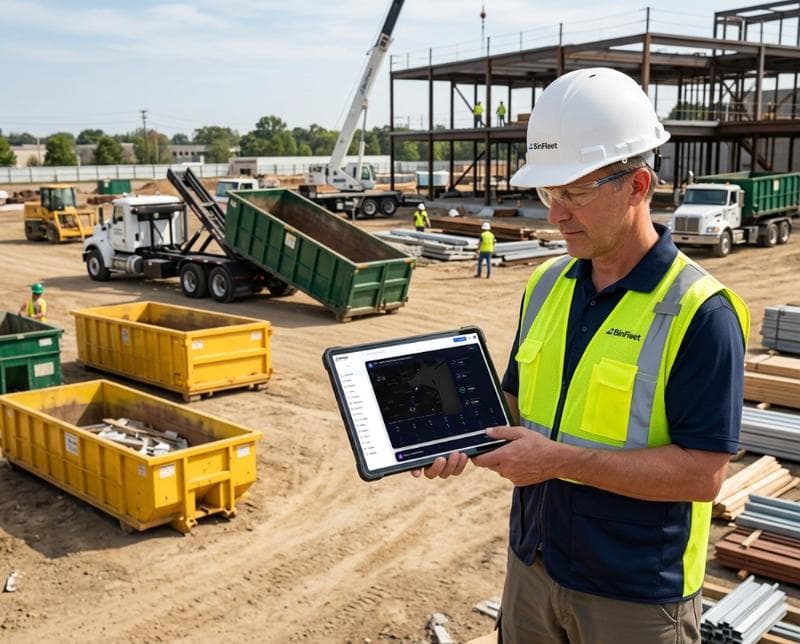
Dispatch software gives you the visibility that spreadsheets and phone calls simply cannot provide. You can see every truck's location on a map in real time, know exactly what's in each container, see which pickups have been completed and which are pending, and track how long each stop actually took. This level of transparency is not about surveillance—it's about understanding where your operation actually runs versus where you think it runs. Many haulers discover that certain routes take 30% longer than estimated, or that drivers are spending two hours per shift on non-billable tasks like finding new pickup locations or waiting for gate access.
Driver accountability improves because the system creates an auditable record of every action. Who confirmed the pickup? What time did they arrive? How long did the stop take? Were there any notes about access issues or customer concerns? This data becomes invaluable for driver training, customer dispute resolution, and continuous improvement. Drivers also respond positively to modern dispatch software because it removes radio static, simplifies navigation with turn-by-turn routing, and lets them see their daily schedule clearly instead than calling dispatch every 20 minutes for the next instruction.
Optimizing Routes for Fuel and Labor Costs
Route optimization is where dispatch software delivers compounding savings that most haulers underestimate until they see it in action. A human dispatcher optimizes routes using experience and intuition—generally creating acceptable but not optimal paths. A dispatch algorithm uses real-world traffic data, distance minimization, time window constraints, and vehicle capacity to calculate routes that consistently beat manual scheduling by 15-25% in terms of distance and time. For a 20-truck operation running 50 stops per day, that's 4-5 fewer trucks needed to handle the same volume, or the same trucks handling 20% more revenue per day.
The software also adapts routes in real time as conditions change. A traffic accident blocks your primary route? The system recalculates and reroutes impacted trucks immediately. A customer adds a same-day pickup? The algorithm finds the most efficient insertion point in an active route rather than forcing a separate trip. When fuel costs $4 per gallon and driver time costs $25-30 per hour, saving 10 miles per route across 20 trucks per day compounds to $30,000-40,000 in annual waste elimination.
Customer Experience and Retention
Dispatch software doesn't just improve your internal operations—it fundamentally changes how customers experience your business. Automated SMS notifications tell customers exactly when their pickup is scheduled, when the truck is on the way, and when the job is complete. No more "we'll be there sometime Tuesday"—customers get accuracy and transparency. When pickups happen on time and reliably, your NPS scores climb, referrals increase, and churn drops because customers simply have fewer reasons to switch vendors. The software also enables customer self-service features like online booking and payment, which further improves satisfaction and reduces dispatch communication load.
This customer experience improvement directly translates to financial metrics. Repeat customers cost 5-10% as much to acquire as new customers but often generate more revenue per year. A dispatch system that delivers consistent, on-time service builds that repeat customer base faster than any marketing channel. Customers also tolerate price increases more readily when service is reliable, which means dispatch software can indirectly improve your margins through better retention and pricing power.
Making the Transition in 2026
The barrier to adopting dispatch software in 2026 is not technology or cost—it's organizational change. Your team has been doing things a certain way for years, and switching systems requires training, process changes, and a temporary dip in efficiency as people learn new tools. Start by choosing software built specifically for waste and dumpster rental operations, not generic logistics platforms that require heavy customization. BinFleet, for example, is purpose-built for your industry and comes with pre-configured workflows that match how successful waste companies actually operate.
Plan your implementation in phases: start with a single yard or service area rather than flipping your entire operation at once. Use the first month to get drivers comfortable with the mobile app and basic dispatching. Add features like automated customer notifications and route optimization in month two. By month three, you should be capturing financial benefits that justify the software investment multiple times over. The cost of modern dispatch software typically ranges from $500-2000 per truck per year, which pays for itself in a single month of efficiency gains for most haulers.
FAQ
Will my drivers resist using dispatch software?
Initial resistance is normal, but drivers typically embrace dispatch software once they experience it because it simplifies their workday. They no longer need to call dispatch every 20 minutes, navigate using separate Google Maps and company instructions, or wonder whether they completed their assignments correctly. Most haulers find that drivers adapt within 2-3 weeks, and satisfaction improves after 60 days. The key is training them properly and explaining how the software reduces frustration rather than adding management overhead.
How long does implementation take?
A typical implementation takes 2-4 weeks for a single yard, including data migration, driver training, and initial configuration. The software setup itself is usually complete in days, but the real transition happens when your team gets comfortable with the system. Many companies see immediate improvements in dispatch efficiency even during implementation because the software is doing work manually from day one.
What if we have complex service areas or irregular routes?
Modern dispatch software handles complex operations through customizable rules and constraints. You can set up geofences for specific service areas, enforce minimum time between pickups at the same location, schedule repeat services on fixed days, and create rules for access restrictions. The software adapts to your operation, not the other way around. Most waste haulers find that dispatch software actually helps them standardize their operations and identify inefficiencies they didn't know existed.
What's the ROI timeline for dispatch software?
Most haulers see positive ROI within 60-90 days through a combination of reduced overtime, fewer missed pickups, better route efficiency, and reduced customer churn. A 10-truck operation typically recovers software costs within the first month once the system is optimized. The real value comes in the second and third years as you leverage data to continuously improve routes, pricing, and service delivery.
Ready to Streamline Your Operation?
See how BinFleet AI helps waste haulers save time, cut costs, and grow.
Request a Free 30-Day TrialRelated Articles
Driver Apps for Waste Haulers: How Mobile Technology Transforms Daily Operations
How a Driver App Transforms Waste Hauling Operations