How to Scale Your Dumpster Rental Business from One Truck to Multiple Operations
Start with Data Before You Buy Truck Two
Most dumpster rental owners buy their second truck when they run out of capacity on truck one. That's understandable, but it's also the wrong trigger. The right time to expand is when you have proof of demand, consistent margins, and operational systems that don't depend entirely on you. If you're running dispatch, customer service, and billing from a spreadsheet, adding a second truck just means you'll stay in that spreadsheet longer.
Before scaling, audit your current operation for three weeks. Track how many calls you're turning away because you lack capacity, what your average revenue per job is, and how much time you actually spend on dispatch versus customer-facing work. If you're fielding 10 calls per week you can't fulfill and your margins stay above 35 percent after fuel and maintenance, you've got a green light. If your current truck sits idle half the week, a second truck won't fix the real problem—it'll just double your fixed costs.
Build Systems That Don't Depend on You
The biggest mistake small haulers make is scaling their own workload instead of their business. When you can answer every call, schedule every job, and solve every problem personally, the business feels like it's running smoothly. But the moment truck two hits the road, you become a bottleneck. Dispatching two trucks manually, managing two drivers, and handling billing for twice the volume will either burn you out or force you to hire—usually without clear job descriptions or processes.
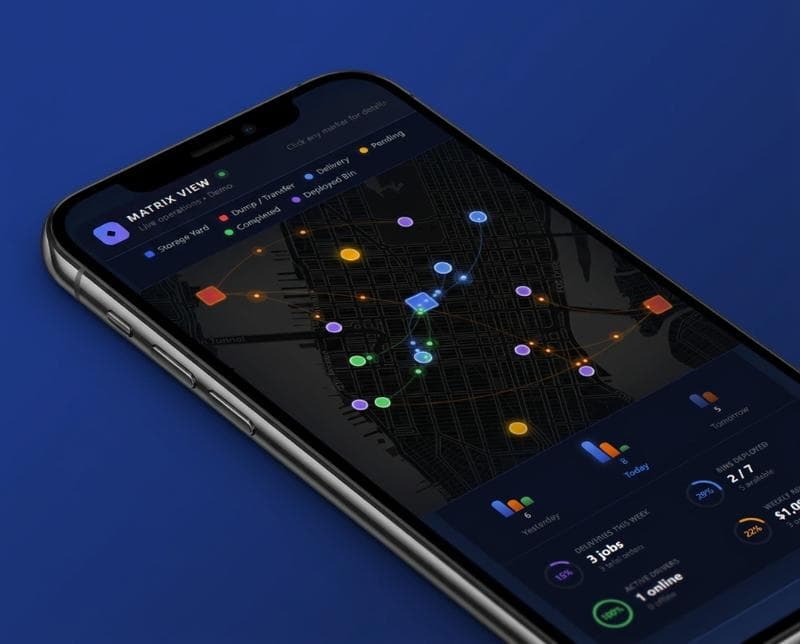
Invest in dispatch and routing software before you hire. A platform like BinFleet lets you automate order intake, route drivers efficiently, send customer updates without writing texts manually, and track container inventory across locations. When your second driver can see their route on a mobile app and customers get automatic pickup confirmations, you've freed yourself from the communication loop. This is non-negotiable if you plan to grow beyond three trucks.
Hire Your Second Driver, Then Your Operations Manager
Scaling feels natural when you go truck one → truck two → truck three. But that linear path often creates chaos. After your second truck is consistently booked, you shouldn't immediately buy truck three. Instead, hire an operations manager or dispatcher who can run day-to-day logistics while you focus on sales, finance, and strategy. A skilled dispatcher working 30 hours per week for $20–25/hour can manage two to three trucks and will surface operational bottlenecks you didn't know existed.
Your second driver should be reliable first, experienced second. If they have hauling or delivery experience, they'll onboard faster, but the ability to show up on time, treat containers and customer property with respect, and communicate problems clearly matters more than past expertise. Establish clear pay structure upfront—whether it's hourly, per-job commission, or a hybrid model. Document your standard operating procedures for pickups, deliveries, container placement, and customer communication in writing, even if they feel obvious to you. This saves arguments later and makes scaling repeatable.
Price for Growth, Not Charity
As you expand, your costs change. Labor becomes your largest expense—a driver in 2026 will cost you $50–65k annually when you factor in wages, taxes, fuel allocation, insurance, and benefits. Your fuel costs scale linearly, but container maintenance, yard space, and administrative overhead scale too. Many owners keep their original pricing when they scale, which works fine when you're one person doing everything. It stops working the moment you're paying someone else to do what you used to.
Review your pricing before truck two fully launches. If you're billing $400 for a dumpster pickup and that only covers truck, fuel, and driver time with thin margins, you're not pricing for a business—you're pricing for a side gig. Talk to your best customers about value, not price. If a contractor saves two weeks of project time because you picked up debris the same day, they're not comparing you to a cheaper competitor—they're comparing you to the chaos of managing it themselves. Raise prices by 10–15 percent strategically. You'll lose some tire-kickers and attract customers who actually pay invoices on time.
Separate Operations Into Zones or Yards Before You're Forced To
Running everything from one yard works fine for one or two trucks. Once you're managing four or more containers, multiple drivers, and routes that cross 30+ miles, a single dispatch location becomes inefficient. The ideal time to open a second yard or designate a second service zone is when your first location is consistently full and your longest routes exceed 45 minutes of deadhead time. This usually happens between trucks three and four.
A second yard doesn't need to be elaborate. It can be a small storage lot 15 miles away where you keep containers, stage equipment, and fuel. The real benefit is that your northern route driver starts and ends in the north instead of commuting 90 minutes daily. Your southern driver does the same. Fuel consumption drops, driver satisfaction improves, and you can dispatch based on proximity rather than desperation. This is also where software makes a huge difference—you need to see fleet location and container inventory across multiple yards in one dashboard. Request a demo to see how BinFleet handles multi-location operations.
Manage Cash Flow Like Your Life Depends on It
Revenue scaling and profit scaling are different animals. You can double your revenue and actually make less profit if your costs grow faster than your pricing. Most haulers bill on net 30 to net 60 terms, meaning cash sits in customer accounts for 30–90 days. Add inventory carrying costs, fuel expenses paid weekly, and driver payroll every other week, and you'll feel cash-poor even when revenue is strong. This is the silent killer of scaling operations.
Build a simple cash flow model that maps when money leaves your account (driver pay, fuel, maintenance, insurance) versus when it comes in (customer invoices). For aggressive growth, prioritize collecting payment upfront or net 15. Offer a small discount for same-day payment—it saves you finance costs and keeps cash in the business for growth instead of customer accounts. Invoice religiously and follow up on overdue accounts within 5 days, not 30. One slow-paying customer with a $5,000 balance can force you to delay truck maintenance or driver raises.
FAQ: Scaling Questions Haulers Actually Ask
How do I know if I'm ready for a second truck?
You're ready when you have consistent demand you can't meet (10+ rejected calls per week), margins above 35 percent, and documented daily operations. If growth depends entirely on you working 60-hour weeks, you're not ready yet—you're overloaded. Take a week off and see what breaks. The gaps you find are your roadmap.
Should I hire a dispatcher before or after I buy truck two?
Hire a dispatcher after truck one is 80 percent booked and before truck two is operational. This gives you time to train them, build your SOP manual, and prove the role adds value before your complexity doubles. If you already have software like BinFleet handling routing and notifications, a part-time dispatcher can manage two trucks effectively.
What's the biggest mistake growing haulers make?
Buying trucks faster than they can manage customers. Your bottleneck is never trucks—it's dispatch, driver quality, and customer payment. Build those first, then scale trucks. A beautifully managed three-truck operation outperforms a chaotic six-truck operation every time.
How do I price service when scaling?
Research your market, then price at the 60th percentile—higher than the cheap guys, lower than the premium players. As you add value through reliability, clean containers, and on-time service, move toward the 70th percentile. Don't undercut to win customers; that race ends with bankruptcy.
Ready to Streamline Your Operation?
See how BinFleet AI helps waste haulers save time, cut costs, and grow.
Request a Free 30-Day TrialRelated Articles
How to Scale a Dumpster Rental Business from One Truck to Multi-Yard Operations
How to Scale Your Dumpster Rental Business: A Step-by-Step Growth Plan